


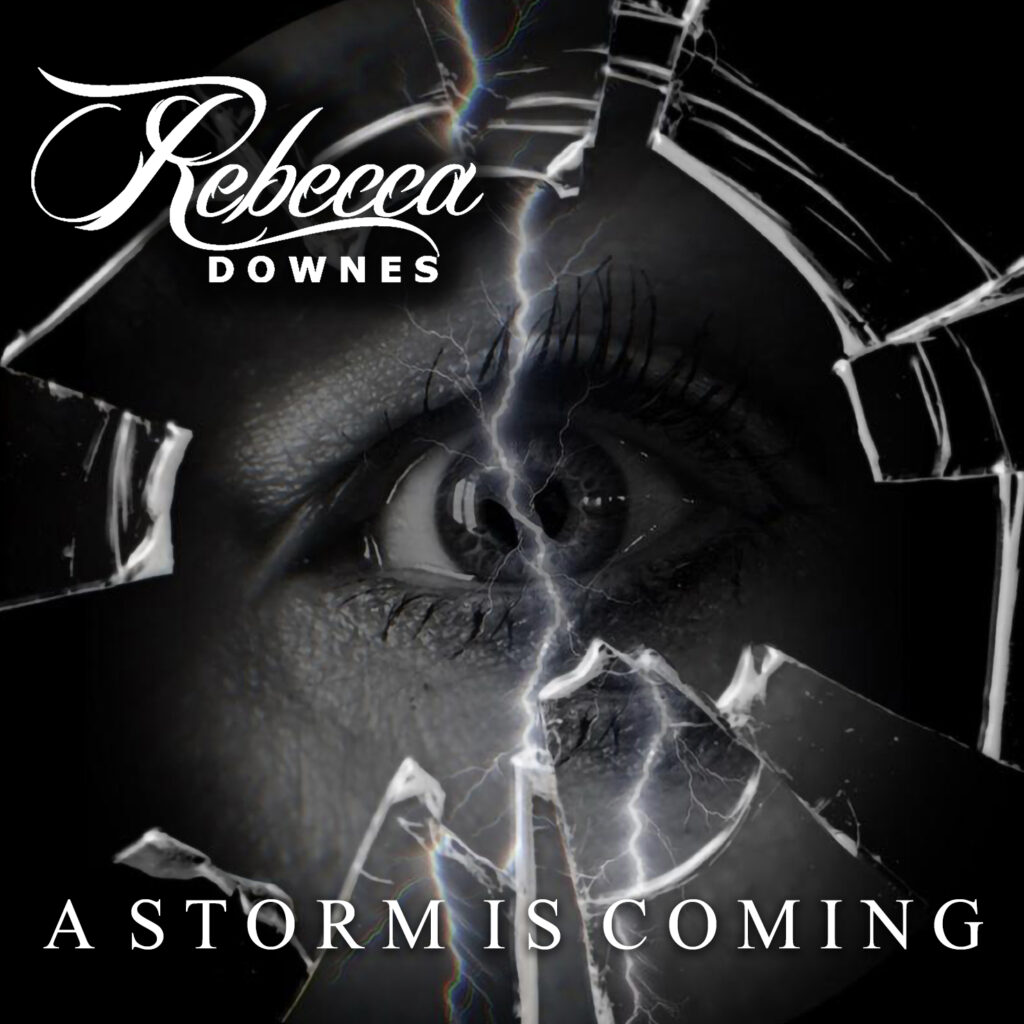
We dive into Rebecca Downes’ artistic universe with a certain curiosity and reverence. A fiercely independent songstress, the Birmingham-based talent has managed to build a heartwarming audience and a longstanding career from the ground up, crafting record after record of blues-rock goodness with an evocative twist. ‘A Storm Is Coming’ is another piece of the puzzle, Downes’ sixth album to date.
Packed with vintage flair and haunting charisma, ‘A Storm Is Coming’ is out today, its ten tracks delivering an anthemic and vibrant aural journey, one that benefits from fuzzy guitars and euphoric organs, but also from poignant restraint and malleable harmonies. Simply, it’s a really good record. With production and co-songwriting by Steve Birkett, the album is ultimately crowned by Rebecca’s elegant, rowdy vocals, oscillating between chaos and softness at a moment’s notice.
‘A Storm Is Coming’ is available as a CD (6-panel digi-pack), as a 180g transparent/red splatter vinyl (with two-sided lyric insert), and on all streaming platforms via Mad Hat Records. Intrigued by the project, we caught up with Rebecca Downes to find out more about her artistry and future plans… Interview below!
Hey Rebecca, thanks for chatting with us! I appreciate the project’s fiercely independent ethos. You and Steve Birkett seem to be building something personal and powerful. Have you had any contact with external companies in the industry? What challenges are you facing as an independent artist?
We are independent by choice, but we will always listen to proposals. Suffice to say that at this point, we’ve not had a proposition good enough to cause us to rethink our independent status. We do have a distribution deal with Cargo Records, which takes care of digital platforms and distributes physical records on Amazon and into high-street shops like HMV, but everything else is done by us with the help of a few other people.
I have just done a series of my podcast (Downes Your Way) looking at the challenges for independent artists in our sector at our level. In essence, the biggest issue is that in a world of 100 million published songs, 11 million artists, about 100,000 new songs a day, and music being consumed increasingly on streaming platforms that pay fractions of a penny per play, it is extremely difficult to generate significant money from music at any but the highest level.
The other big issue in our sector is that we have seen live audiences decline, having never really recovered after the pandemic. This means touring is risky, and I know artists of note who have lost money on tours this year.
This is our art. Steve and I want to write music, perhaps even need to, so we’ve had to work hard to develop a methodology that minimises our financial risk while still delivering material of which we can be proud. The initial reaction to the new album suggests we’ve succeeded in our quest.

Doubling down on the previous question, what’s the one advice you’d give to any aspiring artist out there, based on your experience in the music industry so far?
Dream hard, but stay grounded. There are many ways to earn money from music – e.g. session performer, teaching, instrument tech – so look to develop a portfolio that keeps you going and gives you space to develop your original music. I would strongly advise formal education – there are some great places to study every aspect of music and the business with excellent tutors and often with input from very successful artists.
And in terms of your own music, try to appraise your work honestly, but at the same time, try not to compare yourself to others; everyone’s journey is their own. Don’t get sucked into the numbers game and any consequent temptation to boost your numbers by dubious means (e.g. bought followers, likes and plays). And be wary of the numerous offers of promotion that you will get. Music may be difficult to monetise, but there are lots of people trying to make money from the ambitions of musicians. Some of this is good and helpful, but some is very dubious, so be cautious and seek the help of people whose judgment you can trust.
The need for constant promotion does seem to wear independent artists down, some to the point of giving up, with the biggest challenge being the volume of content creation necessary to maintain a social media presence. I’m afraid this is a fact of life that you just have to embrace. Fortunately, the current generation has been weaned on social media and is perhaps better equipped, but it’s still something that many find challenging. So, work out a way of being able to deliver your content that works for you – either little and often, or big content generation sessions, or some of both.
You may become very successful and famous, but the chances are pretty slim, so plan for the long haul. Be resilient, stay true to yourself, and set out to create a repertoire of music of which you can be proud. And you never know – something may really take off.
You are not only a talented creative but also a successful vocal coach; is that a full-time job for you? Do you engage in any other roles within the music field?
I’ve followed my own advice and developed a portfolio of work. I teach at two universities in Birmingham (vocals and aspects of music business), and I’m currently in the second year of a Postgraduate Certificate in Education. I also do private vocal coaching. Those activities occupy about 60-70% of the working week, giving me time to write, record and undertake all the work necessary to sustain and promote an independent act. Within that, I do have some other music projects, the output of which has yet to see the light of day, and I am always on the lookout for further collaborations and opportunities.

I’d love to know about your upbringing; what motivated you to pursue music in the first place? Is there a particular artist or band that proved to be instrumental in your development?
At primary school, music really started as a way of becoming accepted by my peers. I’d make up songs in the playground, and that helped this rather tomboyish only child to fit in. As a teenager, writing music and performing in bands became a more serious way of expressing myself. Life then took me in another direction, but the itch was still there, and in 2012 I met Steve. The partnership clicked, and I got right back into it.
In terms of inspiration, it ranges far and wide. I did a ‘musical influences’ top ten for a podcast, and the artists I chose were Chris Cornell, Ella Fitzgerald, John Mayer, Queen, Bruce Springsteen, Rickie Lee Jones, Soundgarden, Bonnie Raitt and Joni Mitchell. I would add Melissa Etheridge to that list, and – more recently – Two Feet. My students are always introducing me to new acts (and vice versa), and I am sure that each one that I enjoy leaves its mark on my writing.
‘A Storm Is Coming’ is your latest album, a bold, exuberant and vibrant record packed with a wealth of blues-rock goodness. I’d love to praise your vocals; you are an excellent singer! Are you proud of how the album turned out? Is there a common ‘thread’ throughout it?
Oh, thank you! That is so lovely of you to say that. We are getting some brilliant responses to the new music, which is great, as putting it out there and waiting for people to react is such a nerve-wracking process. So, yes, we are proud of the album, and we hope that lots of people are as enthusiastic about it as you are. My vocals on this album are my best to date, at least in my humble opinion.
I have become much better at advocating for myself and how I want my vocals to be recorded and sound. I feel in the past this hasn’t always been the case, and I have sometimes let people override me when I should have stuck to my guns. I can fight my own corner better now, and with using the EV RE20 mic, I feel like I know exactly how I want my vocals to sound when in a mix.
The album has been described as ‘a ten-track journey from tension to release’ and ‘turning turmoil into anthems.’ It very much resonates with the state of the world today, and I think people see themes in the songs that align with things happening in their lives.
From a creative standpoint, how does your songwriting process unfold? Do you prefer writing alone or with others?
Steve and I write all the time. We generate ideas separately, then send them to each other for feedback and further input. The songs move through this iterative process of development at the end of which, thanks to Steve’s ability to play many instruments along with his recording skills, we have a demo version that gives a good overall feel of the song, the instrumentation and the arrangement. The best of these tracks are then selected to go forward to recording, mixing and mastering, taking account of how they fit together to make a logical collection. So, the songs came together over the last couple of years and the recording, mixing, and mastering were completed this year.
In Series 1, Episode 5 of my Downes Your Way podcast, we explore the creation of the song Stand On My Feet from the More Sinner Than Saint album. It sets out the way Steve and I work in some detail.
I love working the way we do, especially as it fits with our inherent spontaneous nature. I do appreciate that others will have writing sessions or go into a studio to write, but it’s never been something we’ve done. And bringing Steve’s son on board for the mixing and mastering has allowed us to get more intimately involved with that end of the process, and I believe that’s worked really well.
I noticed there’s a great deal of physical merch shipping alongside the digital release. I am particularly intrigued by the lyrics book, that’s something pretty rare nowadays. What can we expect from it?
As I said, monetising music is difficult, especially through streaming. Of the 11 million artists on Spotify, only just over 50,000 make more than $10,000 a year. In our sector, physical merch still has an important role to play in artist income, especially at gigs where people not only buy physical copies of the album to play, but they also purchase items as mementoes of the gig.
The lyric book is something we did for the previous two albums; it was popular with our supporters, and we are hoping it will be the same here. It’s something we can produce in-house, and it gives people a chance to view the lyrics in a readable format, as well as get a bit more background on each song.
What’s next in the album rollout? Are there any live shows on the horizon?
We are waiting for delivery of the merch, then the first job will be to get the pre-orders signed off, packed up and dispatched. We have an album launch gig at the 100 Club in London on 28th October (where we will have merch available) and the formal release day is Friday 31 October. That’s always a busy day (and weekend after) because we have to bring all our online content up to date, post lyrics on the digital platforms, and respond to the (hopefully positive) responses that we will get to the release.
Between now and then, we’ve got a lot of media and promo work to do, and that will carry on through and after release day. We have a couple of gigs in December (Leamington Spa and Dudley), then we have more gigs planned in early 2026. We are hoping that the album stimulates further interest and that we can grow the gig programme for that period and further on into next year.