


Out today, November 6th, ‘The Mechanics of Falling Apart’ marks åhm’s latest EP, a six-track explosion that will leave you hypnotised and fuzzy. Hailing from Sweden, the talented Linköping-based duo features a heightened amount of grunge and 90s references, a feature that gets then drenched in more contemporary elements. The record is out now via Robot Distro/Golden Robot Global Entertainment.
If you feel a great deal of melancholia and gloominess while listening to ‘The Mechanics of Falling Apart’, then åhm will likely have reached their goal. Drenched in dark post-rock and chaotic alternative allure, the EP features dystopian, sombre lyricism on a hard-hitting, euphoric guitar-powered canvas, a formula that manages to convey the uneasiness and anxiety of our times very well.
Intrigued by the project, we caught up with åhm to learn more about their artistry and future goals… Interview below!
The Mechanics of Falling Apart is your latest EP, a six-track affair that finds its roots in the 1990s hardcore and indie scene. That sound is coming back in fashion, so the record does actually feel quite contemporary, yet in a weirdly nostalgic way. What were you listening to back then? Do you have any core memories from that era that you’d like to share with us?
Anders: I started writing songs properly in the 90s, and back then Radiohead and The Posies were the bands I loved most. They shaped how I thought a song could be built and what it could carry emotionally. I remember seeing The Posies live at Skylten, in Linköping, during their Amazing Disgrace tour in 1996. I was completely taken by the energy on stage and by how much feeling they put into their melodies.
That night showed me that a song could be intense and deeply emotional at the same time, and I’ve been chasing that ever since. Growing up in Linköping, it was also impossible not to be affected by the hardcore scene there. It was raw, urgent and very much a community, and that energy has stayed with me even when the music I make is quieter.
Later in life, I’ve come to realise that I was struggling with depression as a kid and teenager, and of course that coloured my songwriting. Writing was where I put things I didn’t have words for otherwise. So going back to that era on this EP feels less like nostalgia and more like picking up a thread I never really dropped.
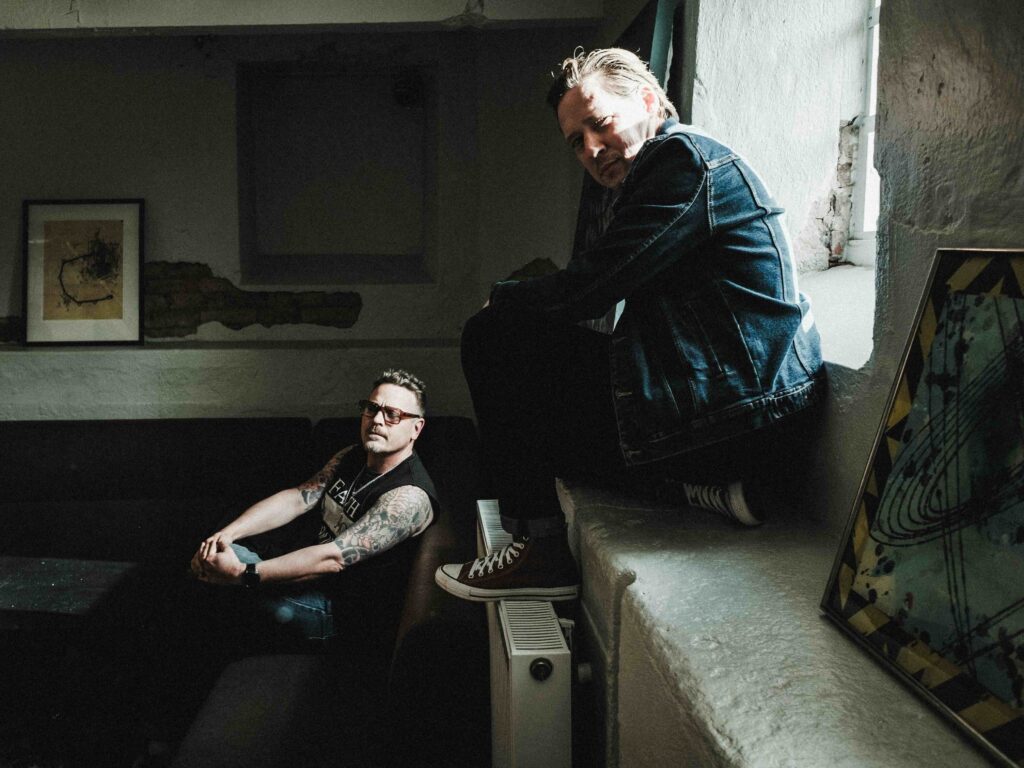
Cribbe: I came more from the heavier side of things. Nirvana, Alice in Chains and Soundgarden were huge for me, but Neurosis became something else entirely. They’re probably the closest thing I have to musical gods.
Jason Roeder’s way of playing has been a massive influence on me. I love how loose and open his drumming can feel — incredibly heavy and physical, but never stiff or over-controlled. There’s movement in it. That’s something I carry with me when I play in ÅHM. I want the drums to have weight and impact, but also to breathe and move with the guitar rather than sit perfectly on a grid.
A lot of my strongest memories from the 90s are also tied to the hardcore scene in Linköping — rehearsals, small shows and being right in the middle of it. What stayed with me from that time is that music didn’t have to be perfect to feel huge. Sometimes the rough edges were the whole point. That’s still a big part of how we work in ÅHM today. We record live, without a click, and try to keep that push and pull between us instead of polishing it away. So when people hear something very 90s in ÅHM, I don’t really think of it as nostalgia. It’s just music and an attitude that never really left me.
What does the EP mean to you? Is there a particular theme that permeates all the songs? What should listeners take away from it?
Anders: It wasn’t meant to be a concept record, but while I was writing it, a red thread started to appear. “Rotors” and “They Drain” are observations of the world around us, of powerful men abusing and preying on the people they have power over. The songs that follow turn inward and describe how that affects us as individuals, and I’ve tried to write them so that almost anyone could recognise themselves in them. Then in “Fall Apart” everything collapses. It can be read as a whole society being torn to pieces, or as one person’s psyche giving way. I like that it can be both. Mostly, we hope listeners feel a bit less alone in it.
Do you have a favourite track in it? A particular song that holds special meaning?
Anders: One song we’re especially proud of is “The Ash of the Sermon”, which we released as a single earlier this year. We’re happy with how the song is built, and the middle section in particular. It’s also one of our best lyrics. It’s very introspective and describes a relationship you have to break free from because you’re broken yourself. What we like most is that it’s ambiguous: it can just as well be read as us, as people, in a relationship with a broken world.
We’re also proud of “Fall Apart”. I like how I sing on it, and it stands apart from the rest of the EP. The music comes from a 20-minute-plus improvisation we did during the studio session, and we didn’t really expect such a good song to come out of it. When I was producing and mixing, I cut out three sections and used them to build the song’s structure. If you know that, I think you can hear it.
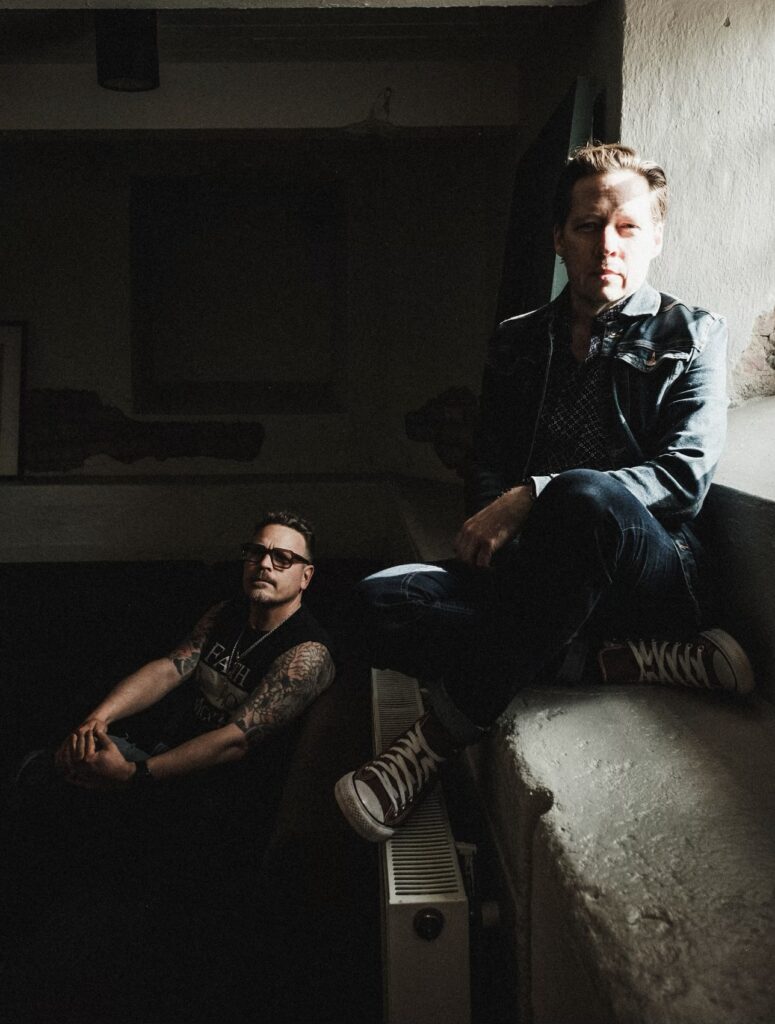
I felt a strong tension between decadent, melancholic melodies and gritty, hard-hitting distortions, a sonic formula that makes for a rather dark and raw listening experience. I am not complaining, as I love that vibe! Also, your music is not always that heavy, but somehow it consistently maintains a murky aura. How do you achieve such a bleak sound? Do you focus more on minor-scale riffs rather than going too hard on the distortion?
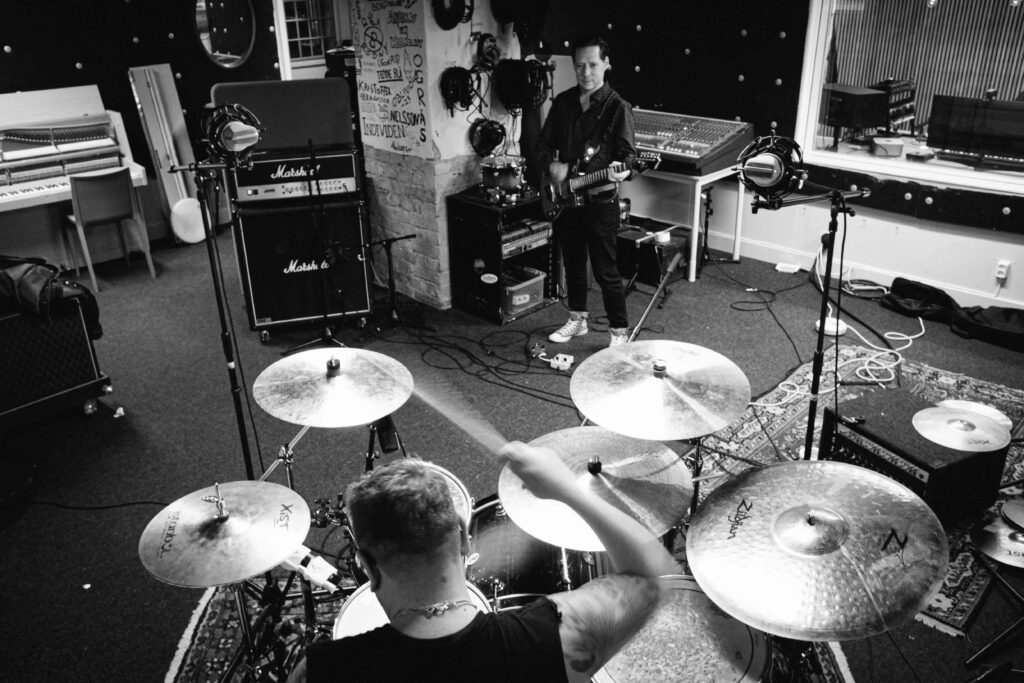
Anders: Thank you; we’re glad the darkness comes across. We think it’s less about how much distortion we use and more about the tension between melody and texture. We’re both drawn to melodies that are sad but almost pretty, and then we put them in something rough, so the two pull against each other. Also, since we record in a small studio where we do everything ourselves, we don’t have the means to isolate the drums from the guitar amp. Instead, we try to mic the drums and the amp so the mics work well together in the mix. Microphone placement is crucial. Especially since we don’t use a click track or headphones when we record. Cribbe is a hard-hitting drummer, so the amp needs amplitude. It’s loud…!
A lot of the murkiness also comes from the production. I record, mix and master everything myself, so I can shape the sound from the first take to the final master. I use tape saturation/simulation to add a warm, slightly worn edge, and I don’t push the master too loud, so the songs keep some of their dynamics. And of course the lyrics matter. Once the words are dark, the music tends to follow, even when the guitars aren’t heavy.
Likewise, does your songwriting influence the music? When writing new material, do you usually start from words or melodies?
Anders: Yes, absolutely, but for me the music usually comes first. I always have riffs, chords and melodies going around in my head, and when a song starts to take shape, that’s where it begins. The words tend to come afterwards and grow out of the mood the music sets.
It’s not a steady process. Sometimes I get into a flow, and several songs arrive within a short time, and other times almost nothing comes for long stretches. Most often, the music shows up when I’m angry or irritated about something, or when I’m in a low period. So the songs are shaped by those feelings from the very first moment, which is probably why the words and the music end up so closely connected.
Widening the conversation, how did åhm come about? How did you meet, and how long has the band been active?
åhm came together in 2024, when we played together during a studio session with another band. We’d actually played together before, in a smaller project back in the early 2000s, with Cribbe on drums and Anders on bass, but it wasn’t until that session in 2024 that the idea of doing something more serious together took shape.
Cribbe came up with the name. We tried “ohm” first, but “åhm” just felt cooler, and once we had the logo, the ohm symbol with a ring above it, we knew it was right.
I suspect you have a lot to say about the modern music industry. Is there anything that annoys you about how the industry functions nowadays?
There’s basically no money for smaller bands. Spotify pays next to nothing, but so many people find and listen to music there that we can’t afford to boycott it. The way Daniel Ek and the rest of the industry treat music, especially smaller acts, is disgusting, questionable investments and all. Realistically, the only way to actually make a living from music is touring, gigging, and selling merch, or getting into film scoring, jingles, or something like elevator music. But if you’re a band like us, and so many others, who just want to reach as many people as possible, you have to be on Spotify and the other streaming platforms.
The one thing we do have control over is everything up to that point. Since we do absolutely everything ourselves, from the first mic on the kick drum to the final master, at least we know exactly what happens to our music before it ever reaches a listener.
Lastly, what’s next for åhm? Any live shows on the horizon?
Unfortunately, no shows on the horizon, even though we’d love to. Right now åhm is just the two of us, so to play live we’d need to bring in at least two more members and actually rehearse as a full band. But people have started showing real interest, and it’s made us hungry to play live. We’d be great.
Other than that, we’re in an incredibly creative phase right now. Songs are pouring out, and the state of the world gives us plenty to write about: madmen in positions of power and the damage men are doing to the world, in particular. Anyway… We’re going into the studio soon to start the next project. It might end up being a full-length album.