

We are always interested in the merger of different musical mediums, and that’s perhaps why we found Monti Korbelle‘s latest work so endearing and interesting. Hailing from Denver, the multifaceted creative has unveiled ‘Postbellum’, a record that thrives in leftfield electronica and an unconventional music video. Imagine gritty dubstep-influenced production and commanding hip-hop vocals, all wrapped in hypnotic allure and haunting emotional contour.
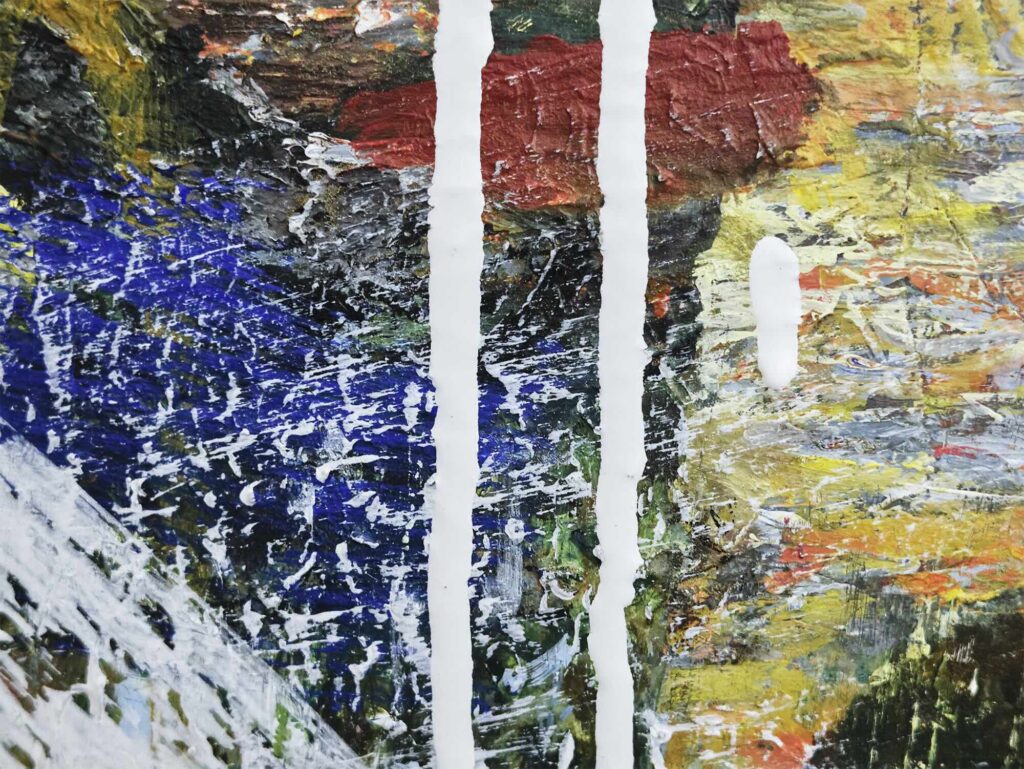
Then, imagine an intimate photo series that follows a 30 x 24 canvas as it evolves over time. The video is not merely a companion piece, but we’d argue that it’s an integral part of what Korbelle is trying to communicate with ‘Postbellum’. It’s here that we catch a glimpse of Monti’s visual side, as he unfolds different painting techniques to achieve a kaleidoscopic result.
Intrigued by the project, we caught up with Monti Korbelle to learn more about his work and future plans… Interview below!
Hey Monti, thanks for chatting with us! I have spent some time digging into your latest work, ‘Postbellum’, and I appreciate the highly personal art you are making. This is truly peculiar musical practice, and there’s a lot to uncover. First of all, a general look at who Monti Korbelle is: how would you define yourself?
Finding words to define myself is one of my greatest shortfalls, which is why I actively push to discover these other forms of expression. My name is Monti Korbelle, and I am a music artist, but this is also an interesting time in my life, maybe a keystone to my life in some manner, with all of my optimism associated, where I happen to have become ecstatically compelled to expand from within and then also upon myself the other potential avenues I can attempt expression through.
My newest project ‘Postbellum’ is a look into my early workings with that concept, as it directly focuses on my processes of abstract painting shown in all its painful details. It excites me incredibly to activate the brain in all of its colourful ways.
‘Postbellum’ blends gritty and digital-esque dubstep influences with mangled spoken words and hip-hop-leaning vocals. I’d be curious to know if there are any influences behind this choice, or if it’s a formula that came to you, free from outward factors.
Well, admittedly, and actually it is becoming cool again to say this, so I should find comfort within myself to share this, I have always had a place for dubstep in my heart. My fascination for dubstep began in the early years of the genre, during its first wave of popularity. There were then a few years beginning in the 2010s when the genre became… sort of cringe. But today, we’ve enjoyed a reflourishing of electronic music in all sorts of beautiful ways with rave culture and the like.
It feels like I fit into the world again through that layer, and so my production motivations for ‘Postbellum’ were an ode to that. And of course, I cannot place for Postbellum to have any claim to dubstep; I admit that as well, and so the other layers of its production are much more broadly ‘mood’ inspired over genre-influenced. Bringing that all together into one production is what gives it the unique sound that I believe it carries.
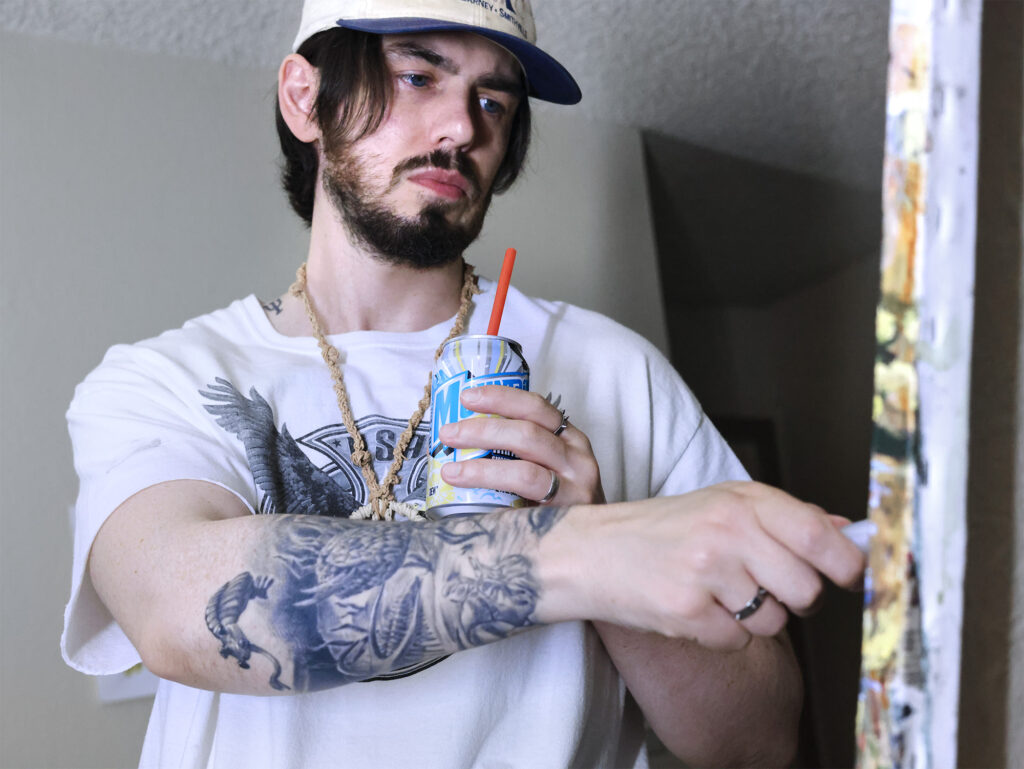
The record ships with a meaningful music video that’s rather central to the whole sensory experience behind ‘Postbellum’. It contains an intimate photo series that follows a 30 x 24 canvas as it evolves over time. It’s quite a mesmerising watch, I must admit! Let’s start with its connection to the overarching music; what can you tell us about that?
A painting is something that intrinsically has a beginning and a finish in regard to its creation, which in most cases is not a story expressed as part of the finished painting when viewed, usually hung on a wall somewhere. Yet I was sort of fascinated by this sort of behind-the-scenes storytelling in a way that shows something being built.
Lyrically, ‘Postbellum’ speaks about having to “go to war with you.” After any sort of ‘war’, (and it should be clear I mean that symbolically), there is seen a matter of changes. A war is transformative. And so carrying that is the symbol of the butterfly we see in different layers of the painting, as well as the painting itself acting as a vehicle for the symbol of transformation. The canvas moves from one that is blank and then with some layers to something that is layer-rich.
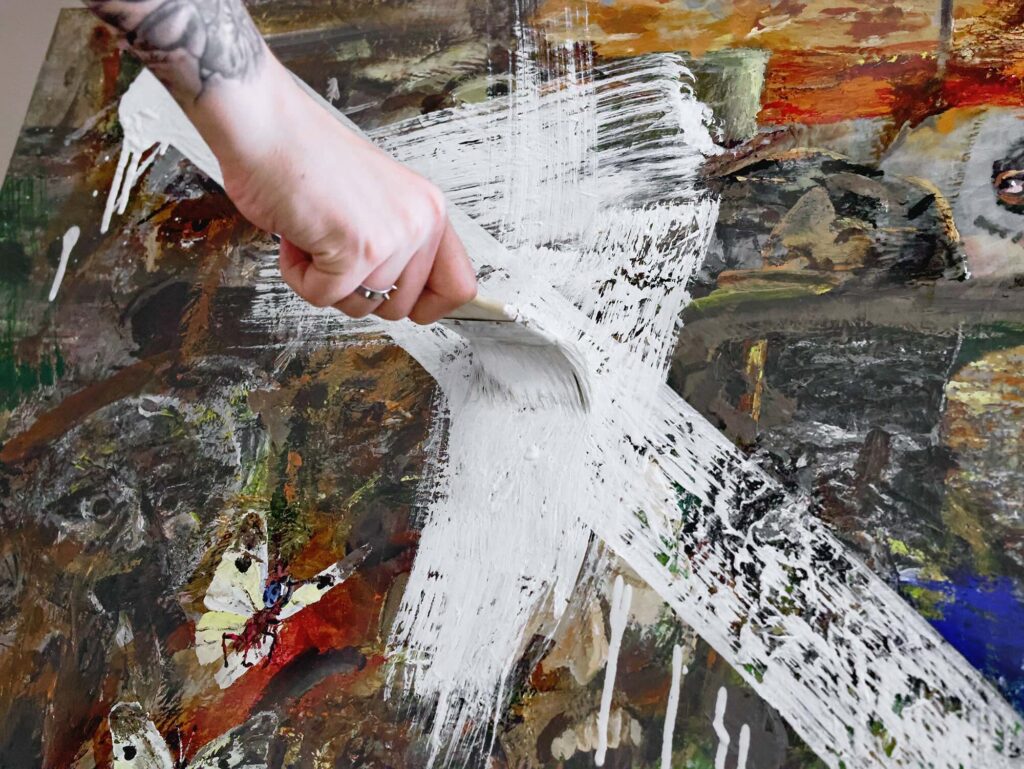
The canvas series features a mix of painting techniques; how did you go about blending them? Do they convey a different emotional state?
It was my intent for the layers of the painting to carry storytelling as they were documented. ‘Postbellum’ has lyrics making references to “war,” and so in the early layers we see a range of deeply saturated carnation reds. And so really, if I am being totally transparent in showing my hand of true intentions, this is the “scene” in which we are establishing the beginning of a transformation.
From this point, it is put into my creative control to steer the arc of this transformation-story towards wherever this one goes. In some images expressed by the painting, I tell small stories, but in other ways I am telling longer stories. My favourite moment in the painting’s development is a layer that, to me, resembles a woman sitting in a city park watching the sunset.
Now, however, we are dealing with an abstract painting entirely, so one may have to squint their eyes to see it or even find it, but to me the image is clear; and it makes me wonder what stories are clear to me, expressed by the blobs and strokes and colours in this vibrant abstract expression, and what stories are clear to others that I should feel completely blind in response to have realizing completely missing the expression.
To me, though, if I were to insert my authority as the role of the painter, the broader story or stories are on the sadder side. Things occur that are irreversible, and in my view, as the stories unfold, upon my response to the images, I see tragedies. But I also see responses to tragedies. And then there are also the things that are beautiful and nice. What I am trying to say is, art is in the eye of the beholder.
You might already have mentioned this, but there’s a lot of butterfly symbolism throughout the video. Can you expand on how it connects to everything else?
Butterflies are a symbol of hope in a broader context, and ‘Postbellum’ is part of an album in progress that exhibits this message. In the song, the layer at which I want the butterfly understood as a symbol is its transformative nature. A concept I am fascinated by is what we observe as a general permanence to transformations. The butterfly never switches back and forth from butterfly to caterpillar and back again as it pleases. It seems there is a lesson in that, not to say there is a rule to be learned, but rather a story to observe and gain insight from.
From a music standpoint, are you responsible for the production of ‘Postbellum’? If not, who was working with you? I’d love to know more about how you approach the creative process, musically speaking.
Postbellum had a long journey in its production, as many of my songs do. Funnily enough, the music video, with its theme of transformation, tells a similar story. Originally, there was no dubstep or even electronic influence in the production at all. I might release a fleshed-out version of what the song originally was someday as a totally different song, and it only “transformed” because I felt it sonically clashed with the other songs on the album it is set to be included on, but it originally was a song with strings and a cinematic feel.
I’ve made a song like that in the past called ‘Waves Without the Ocean’, and so, feeling like I wanted to do something different and fresh, instead of just doing the same trick again, felt like the right move to make at the time. The track transformed from an orchestral-supported song to one that is electronic music and hip-hop influenced. Some of those big cinematic drums heard in Postbellum were actually carried over from its “original form.”
I love the tagline on your website, ‘reject background music’. Everything you make seems to be highly intentional, with the sole purpose of intense personal expression. Am I correct on that assumption?
It is important to have thought be provoked; things occur as a cause, and that is valuable, and at times I find myself compelled to push for this as a value when there is something positive to bring forth or bring service to. There are constantly conversations being had, and that is essential, but I wonder what conversations could be had through the action of listening to music. This includes understanding how the music moves you. We are complex creatures, and we understand things profoundly in a multitude of unique ways. I like to speak through music, and exploring that feels good to me.
Lastly, what’s next for Monti Korbelle? Can we find you anywhere in the real world? Perhaps an exhibition or a show?
As much as I really enjoyed finding practice in expression through the visual arts, in this case, painting, I really, really must put my headphones back on and practice what’s truest to me, which is music production. ‘Postbellum’ is one track on an album I have been crafting for a couple of years, and it is a project that means a lot to me. There are many, many stories to be told, and this concept- storytelling- truly is extremely important.