

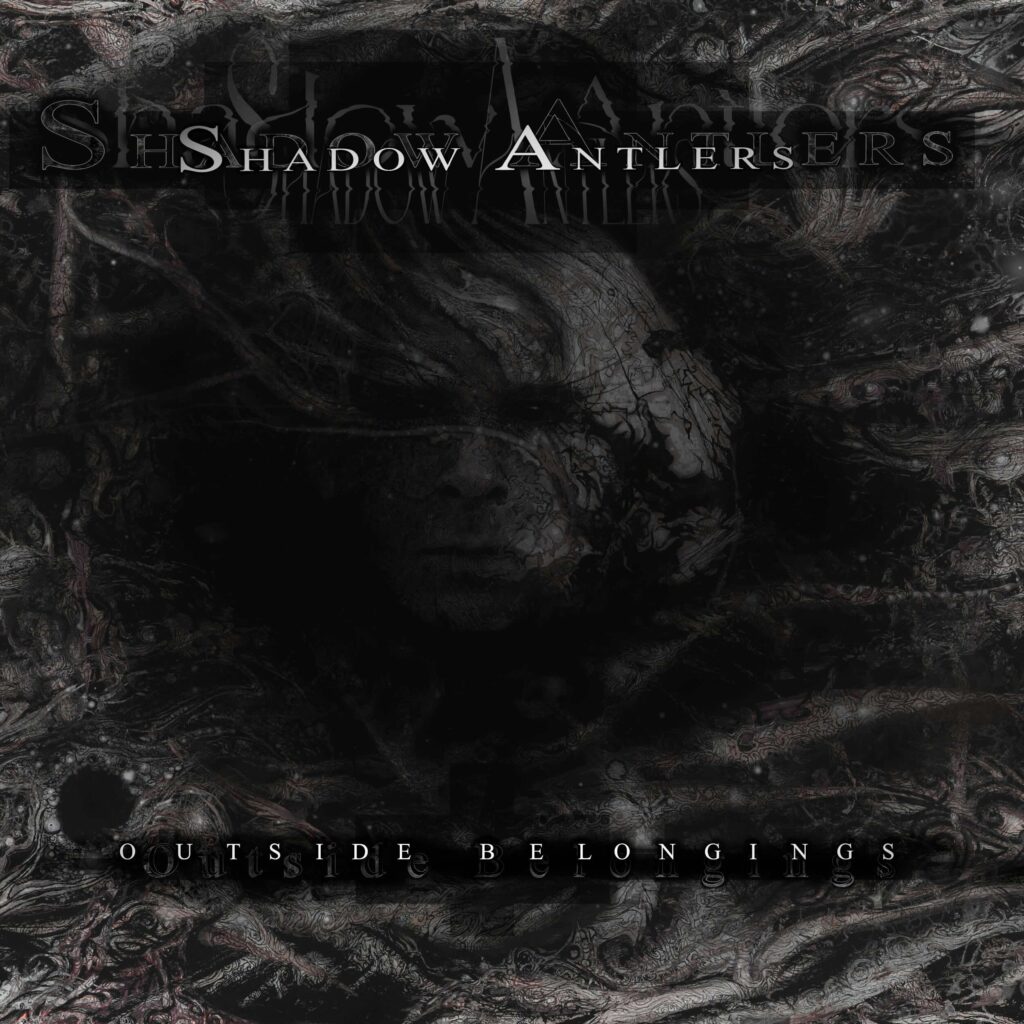
We are going to go ahead and boldly describe ‘Outside Belongings’ as a challenging record. In a positive sense. Incredibly dark, haunting and intense, the album develops a fringe aural space that’s unconventional and chaotic, one where one’s beliefs shatter against a wall of gritty noise and industrial catharsis. Packed with twelve boundary-pushing episodes, ‘Outside Belongings’ navigates the borderlands between darkwave, post-punk and experimental music, making for an eclectic and hypnotic record, one that’s guided by Shadow Antlers’ prophetic, dystopian vocals.
Hailing from Gothenburg, the talented producer and songwriter champions a strong DIY effort, fiercely and fearlessly pursuing his unique sonic vision. Also known as a member of Swedish noise rock/post-punk band RAMN, Shadow Antlers crafts material that’s inherently personal. While his musical influences are clear, we must not forget the alternative imaginative ethos that propels the project forward, with ‘Outside Belongings’ continuously building a fictitious world that’s guaranteed to capture even the most apathetic listeners out there.
Intrigued by the project, we caught up with Shadow Antlers to learn more about his unique artistry and bold creative vision… Interview below!
Hey Jakob, thanks for chatting with us! I approach your project with great curiosity and a certain reverence, as I recognise its meaningful lyrical premise and the dark, obscure imagery behind it. We have already introduced Shadow Antlers in this article, but I’d love to know what the project means to you, on a deeply personal level, going beyond its ‘press-release-coded’ description. Is it a way for you to process certain emotions?
Hi Gab, thanks for having me! I have, for a very long time, wanted to do something dark, noisy and rhythmic but still cinematic. I have been experimenting with this eerie, layered kind of soundscapes for a while, searching for the right way to place them within song structures.
A year ago, after a very busy year, I had a physical and mental breakdown. Now, this has happened before in my life. As a person with KSC (ADHD), hitting the wall because you didn’t see slow stress build up until it’s too late is something very common. The abbreviation KCS stands for Cognitive Kinetic Style, and it comes from neuro-activist networks, of which I am a part. It means that your perceptive system searches for what moves, what vibrates, and itself is also constantly moving, intuitively prepared for improvisation. It orients your cognition toward tension, excitement, and moments where you have to be immediately present.
This is a state that requires a lot of energy. You move toward intensity, but you are less prone to see what might come after that intensity. You are a creature of the moment, and your time perspective is now. You are in the now. Later is an abstraction that you intellectually might learn to understand and appreciate, but that you will never have an intuitive understanding of. Your time perspective is not linear, not chronological.

So, I have experienced those breakdowns a number of times, and I have learned not to be too afraid of them. But a year ago, my physician urged me to take a couple of months off from my (new) job, and to seriously ponder the question: Wouldn’t I really, at least for once in my life, try and live as an ordinary person? Without the intense highs and lows, without the slow stress of worrying for the future. And he prescribed to me some medicines to help me sleep, to build up hormonal levels, to take down occasional anxiety, to deal with side effects of the other preparations and so on. He understood where I was coming from – he even recommended me to continue some daily making of noise drones (“With a lot of bass frequencies in it. That’s great for the vagus nerve!”) – but provided me with the opportunity of trying to live as such a creature for which this society was designed: a citizen, something that I had never felt like.
In my time on leave, along with adjusting to the meds, I slowly got back on my feet, and I made my noise drones. And I played my guitar, and I turned synth knobs. And in time, I got back to work, and finished musical pieces had started to appear on my computer. For some reason, during my convalescence, I had obtained the ability to actually make the noise concrete and pronounced enough to form structured songs. By this time, my partner noticed that the lyrical contents of my new songs all seemed to treat the same themes: defiance, running away from duty, refusing to conform, and escaping the grid.
As she made me attentive to this, at first, I was stunned. Then, I was proud. Then, I started phasing out my meds, and I also realised that my vision now was clear enough to start carrying through the darkwave project that had actually lingered in my mind ever since my teens.
That’s a long story. But also necessary in order to reply to your question: Yes, the Shadow Antlers project is deeply personal. And it has obviously been a way to process certain emotions – at first, emotions acting from a subconscious level, then by using the project as a very conscious amplification of these emotions once surfaced. Because these emotions are not emotions originating from trauma; they are not emotions for which I am ashamed, or that I strive to get rid of or to obliterate.
On the contrary: they are emotions of defiance, of pride in what and who I am, a celebration of the wildness that underlies the surface of citizenhood within me, and – ultimately – within every human being on earth. Because we are animals. I am one, you are one too. And however we try and culture ourselves, force ourselves to conform to social norms, to medicate and anaesthetise our true animalic essence and train off our instinctual drive toward freedom and creativity – however we learn to suppress our nature as actually being instinctual and creative creatures – somewhere inside, wildness remains. That is the final truth. Do not fear it; love it.
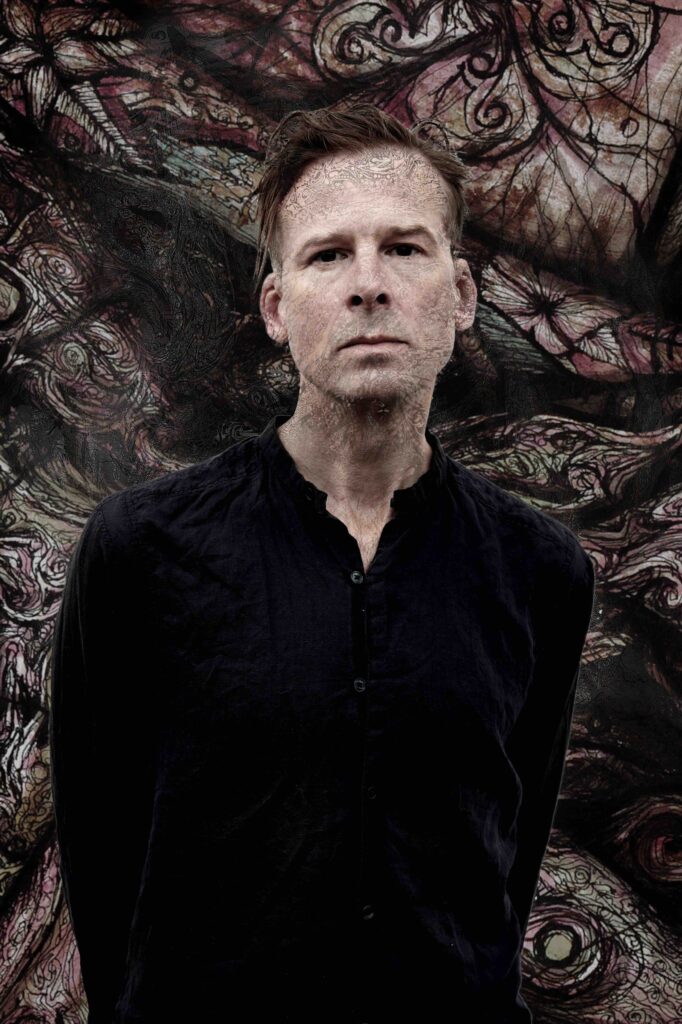
You have mentioned taking a bunch of pills to become ‘an average person’ at the start of the year. As I understood it, you do thrive in the unconventional and the unseen, and perhaps Shadow Antlers is a reflection of that?
Most certainly. Since I was born, I have always been attracted to anything mystical, obscured, halfway out of sight. When I was a child, fantasy literature; in my early teens, musical subcultures; as a young adult, underground culture such as magick, geek culture or obscure and inaccessible philosophy. And I have not abandoned any of these interests, although they have tended to wax and wane during the years.
As a young man, psychologically reflecting upon myself, I used to believe that all of this expressed a fundamental insecurity in my own abilities; a drive toward escapism from reality. It was my ADHD diagnosis, received during adulthood, that actually made me think in other ways about myself and my, sometimes disharmonic, functioning in the world. What if I actually wasn’t an insufficient person at all? What if I actually was exactly what I was supposed to be, but the world was built for someone else? I have never really trusted language and its stated ability to represent the world as the world really is.
I have never felt any real wish to conform to social norms. Social reality and its symbolic systems are just not so true to me. To me, intensity is felt when I am close to that which escapes social classification, that offers pathways or lines of flight away from the gravitas of everyday habit, that has an aura of otherness, even danger, to it. My drive toward the unconventional and unseen is not a drive away from experiencing reality; it is a drive toward experiencing it in a way that, to me, is truer and much more real. And I believe that as a KCS person or an autistic, your brain is less predisposed to believe in social norms and more likely to seek ways of experiencing the world than most others.
Shadow Antlers is this insight or impulse formulated as an artistic statement directed to everyone. A wildness lives within you, a wildness of which you can never have an unambiguous perception. It is actually the core of what you are. And this society is one built on illusion, on a conventionally agreed hallucination; that it is the natural ecology for us humans, that our social norms are an ontological fact. But they are not. Feel your wildness. Be proud of whatever you have that defies social norms. Embrace the chaos of nature and of life; enter the wild of the real. Affirm and love your animal spirit, because it is what you are.
‘Outside Belongings’ is your debut album, a striking record packed with twelve gloomy, melancholic episodes. Ranging from industrial post-punk to leftfield electronica, the release is pretty unique and niche, quite chaotic at times. What were some of your influences for it? Have you produced the record yourself?
‘Outside Belongings’ is a response to, or a realisation of, something that has been lingering in my mind for a very long time. In my teens, it was the earliest incarnations of the darker legacy sounds – the mid-80s European postpunk, Australian and Canadian aggressive electronics, Neue Deutsche Welle, the British industrial and apocalyptic folk scenes – that exercised a gravitational force (of sorts) on me. When I started playing and composing music myself, my preferences had shifted toward the American underground scenes of New York, Boston, Chicago, which have since then been reflected in my music, even if it has preferably been the darker side of that music – noise rock, everything Albini, record companies such as Kranky or Touch and Go, math rock or No Wave.
Shadow Antlers is my reunion and my reconciliation with the music of my early youth, executed and crafted by someone whose sensibilities as a musician have been shaped by playing more violent and chaotic guitar music. Early Sonic Youth themselves attempted to make atonal, electronic ambient storms like those made by Cabaret Voltaire or SPK, but on guitars instead of synths. Having learned to shape my soundscapes with guitar noise, I use Shadow Antlers to bring them back to electronics.
The album that has been the inspirational pillar for ‘Outside Belongings’ is the 1986 John Fryer-produced ‘Medusa’ by Dutch band Clan of Xymox. I think the producer is as important as the artists on this particular album. When I heard it as a boy, it sounded like nothing I had ever heard, with its cinematic ambience and the distant vocal, the distorted samples that echoed out into space. It has been a silent inspiration in my life ever since, and when I started conceptualising ‘Outside Belongings’, I knew that ‘Medusa’ should act as a reference. In fact, ‘Cellar Door’ is a direct reference to Medusa’s closing track ‘Back Door’.
How far is ‘Outside Belongings’ from your work with Swedish noise rock/post-punk band RAMN?
In another interview, I stated that RAMN and Shadow Antlers “both move within the same post-punkey, mystical territory of austere Norseness”, which I think captures the similarities. There is also a certain aversion toward traditional song structure present in them both. The sounds are very distinct, though; RAMN is riff-based, explosive and sonically extreme in a very forward way. RAMN drums are extremely simple; part of the concept is only using two or maybe three sounds on the drum machine, just four bars, and preferably using the same patterns for several songs. That grew out of our decision to use a very simple drum machine and not having to have a specific band member for managing it during live shows.
Shadow Antlers is more about ambience and aural strangeness. Constructing a world in which the music lives and modulates freely.
Take us through your songwriting process; I take it that you prefer writing alone? Do you usually start from the lyricism or from the musical composition?
Yes, it was important for me to make ‘Outside Belongings’ completely by myself, all the way through. Every sound on the album has been tweaked, programmed, played and recorded by me, same as every lyric on it. Doing it that way felt like an homage and tribute to 14-year-old me. Channelling him through time into a body that was able to do what he was not.
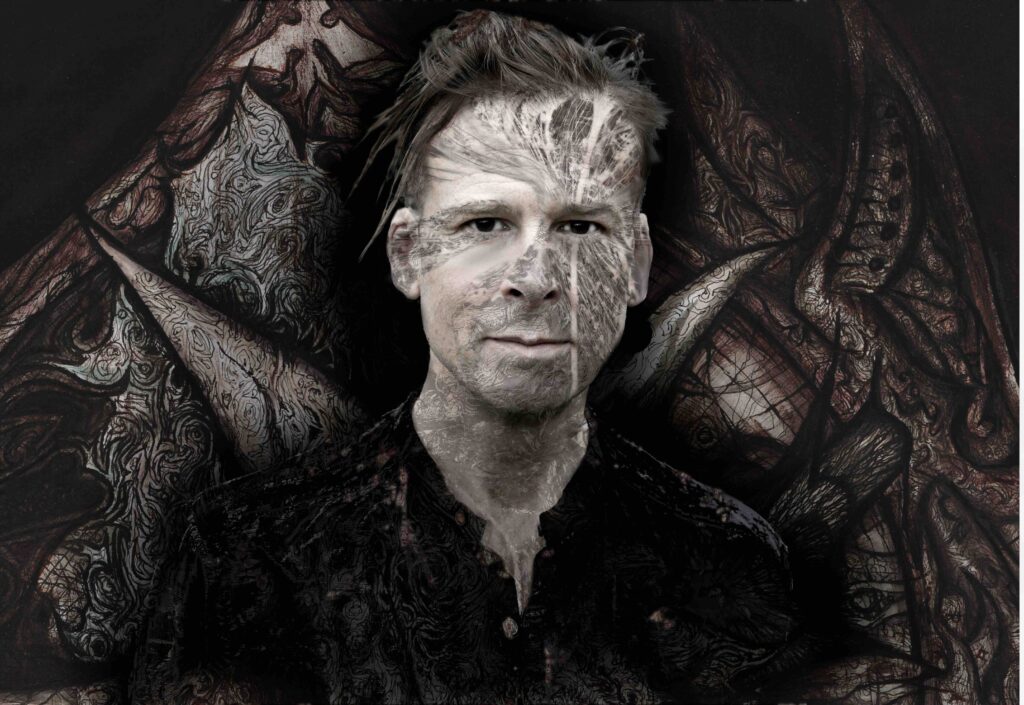
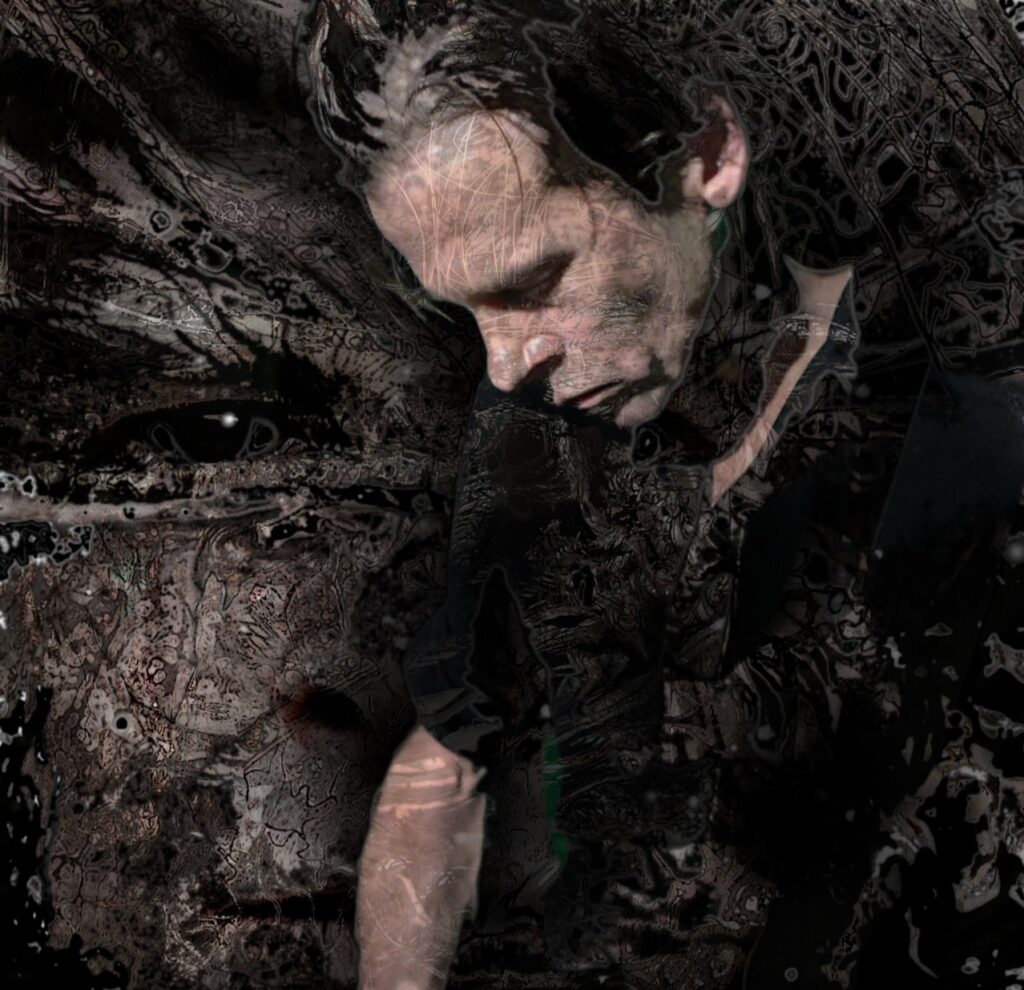
Not only the music, but all the graphics used are made by me. The visual material consists of photographs taken by artist and photographer Jessica Johannesson, who is also my partner and the only other person I’ve allowed into this process. Meeting her four years ago was instrumental in putting me in contact with my old self, the inner little boy I have mentioned above. The portrait pictures are not used raw, though, but in overlayered montages, combining them with my ink drawings. I also make small videos with morph animations based on the montages, mainly used on social media.
Composing for Shadow Antlers always starts with the bass. First with the sound itself, most often tweaked from a synth preset or just from zero; it has to have attack, a very present physicality and enough grittiness to break through a booming bass drum and a really punishing snare. Then crafted into a bass line as simple as possible, preferably consisting of only one note. After that, I let the bass line boom away in my rehearsal room or in my home with a simple drum pattern.
Harmonies are found on guitars or synth pads, vocal melody comes last. Words are used mainly to have something to sing, which is why I was kind of surprised when Jess pointed out that the early songs actually had a common theme to them! But the drums and the bass line stay consistent during the whole song – basically, they’re EBM songs but with strange melodies and harmonies and with a noise rock-ish and layered execution of soundscape.
So there you are. The songs grow out of a very simplified bassline, which remains their beating heart still in their recorded end form. The whole composition and soundscape grow out from the bass. The words come last. Always. After completing this album, I don’t think the whole ‘working alone’ M.O. will be necessary. Next time I’ll probably invite other musicians, work with a producer, write songs together with people, and maybe cooperate with artists.
Would you like to shout out and remember Elspeth Probyn? What is your connection to the late Australian author?
I was a cultural researcher for a while. Quite a big part of my life, actually, and I have a PhD in a cultural science branch. In the distant beginning of my studies, I was searching for ways of understanding the human, cultured animal in ways that resonated with how I intuitively perceived the world. And I had a really hard time doing so. Then I came across the neo-materialist ethos, which had just the kind of aura that draws me in – poetic and strange, lacking the usual commonsense understanding of the human as something standing above nature and in an ontological sphere of its own. But it also opposed the stupidness of biologism and reductionism and understood the world as a tangle, a chaotic, beautiful mess, a promiscuous and complex ecology of becoming that could only be understood through its relations.
I found Elspeth Probyn’s book ‘Outside Belongings’ when I was looking for ways of uniting this complex, seemingly backwards way of thinking with how to think about my own life and my place in the world. And it moved me. There were stories from her own life, stories of how the human desire to belong was overriding social categorisations, how a “self” was not carved from the void but emerged only in relation, and that those relations were what carried ultimate reality. Outsiders creating their own communities away from the penalistic gaze of normative society. The figure of the horse-girl; the mutual becoming of the horse and a girl in the act of riding and living a horse-centred life. These were stories of things I had no personal experience with or connection to, but that moved something within me very deeply. The experience of being an outsider, I recognised. Also, the grave importance of leaving the conscious self, intensely merging with something outside. Being and longing. Becoming and desiring.
As an academic, there might have been things that I didn’t agree with – I don’t really remember, and it is not of importance because the phrase ‘outside belongings’ stayed with me. When my Shadow Antlers project began to materialise in form back in February, I knew what was to be the title of the book. Sadly, I didn’t reach out to the author herself already then but decided to wait until the album was ready to be released, which is now in November. Had I contacted Elspeth Probyn right away through her place of work at the Department of Gender and Cultural Studies at the University of Sydney, I might have reached her to thank her and pay my respects. But I didn’t, so I missed her. She died on April 8.
But still, if you somehow can hear me, Elspeth: Thank you for the book. Ok if I use the title? I promise that I will be respectful and true to its spirit.
Widening the discourse, do you feel like ‘Outside Belongings’ well adapts to our destructive and troubling times?
The world gets stupider by the day. Artifice gets more impenetrable, social media constructs new ontological layers, layer on layer of artifice. Fascism rises all over the world, and fear of the abject or deviant runs rampant. But also, the fragility of the ecological systems gets more visible by the day, and this fact gets more and more recognition. Real human differences are made more visible than ever, and the naturalisation of dogma such as heterosexuality or the two-sexes model is crackling under new scientific research that gives a more complex picture. And so on. In most ways, though, I believe it to be a historically difficult time to be human, on an existential level. The bare width of possible discourse about yourself and your place in the world is astounding and overwhelming. What the hell are you? All kinds of stupidness fight to get you on its side.
Outside Belongings might remind you that at your core, you are a wild thing, and at your core, you belong to the world. I believe that there is healing and forgiveness in that insight. Everybody needs that. The world needs that. And the world needs reconciling with the strange.
What’s next for Shadow Antlers? Any plan to take the project live?
Yes! And that might happen in several ways. I am surrounded by fine musicians and artists and have access to a collective rehearsal space that I also used as a club venue here in Gothenburg, Sweden, called Studio Chanslös – itself a place of outside belongings. But I think I’ll start just standing barefoot on a concrete floor in a basement somewhere. With a microphone, a loop pedal and an enormous PA system.