


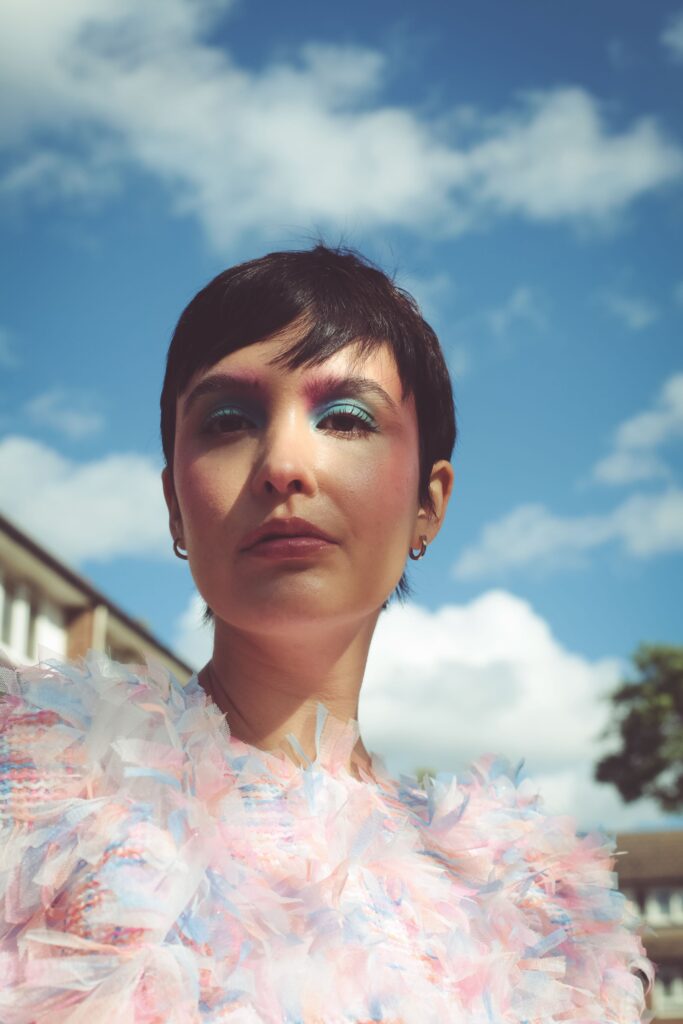
A fierce purveyor of authenticity and cathartic personal expression, Salwa embraces a cohesive, holistic look over her own creative practice. Art mediums are mangled towards a common goal, an ethos that makes the London-based visionary able to decode contemporary reality in a peculiar and relevant way. Of Scottish, Lebanese, and Palestinian heritage, Salwa has recently taken a keen interest in the ancient concept of scapegoating, drawing a parallel with the geopolitical and cross-cultural reality that has informed her personal experience.
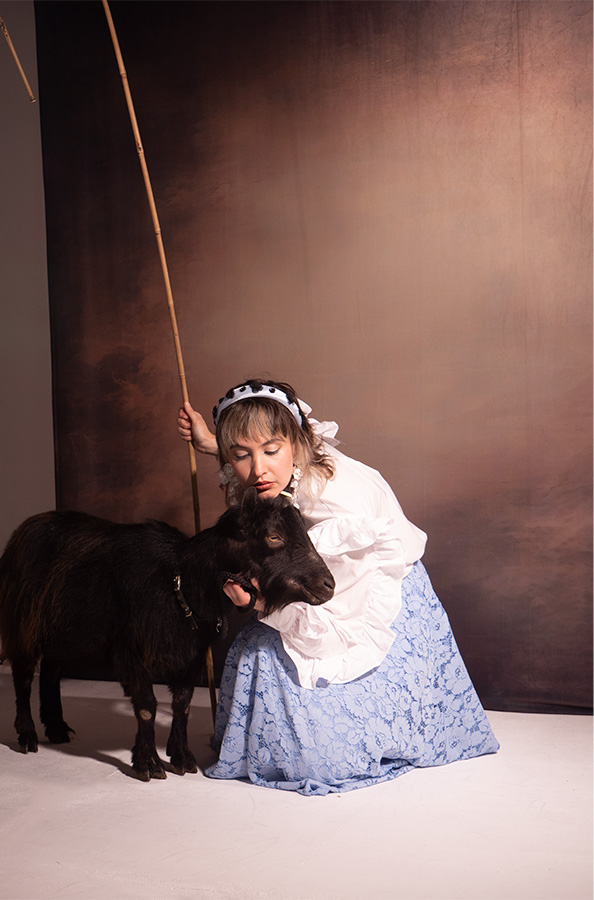
‘GOAT’ is the final result of such deep artistic research. Shipped with a musical piece and a striking video that borders on art performance, the record contrasts a seemingly playful and quirky alt-pop production with cryptic and layered lyricism, something that gracefully weaves into the goat-coded visuals. The video will be unveiled on June 5th; you can catch its premiere here.
Intrigued by her unique artistry, we caught up with Salwa to learn more about her inner philosophy and personal history… interview below!
Hey Salwa, thanks for chatting with us! I have explored your artistic project a fair bit, and I am impressed with its holistic nature; your artistry doesn’t necessarily differentiate between media, instead using the aural, sonic and literary realm to build a compelling thematic canvas. Do you consider yourself more of a musician or a visual artist?
What an interesting question! There’s definitely an element of push and pull between the two. I’m a classically trained pianist, and when I was growing up, I played in a few indie/rock bands on synth and bass. I always felt I was a bit of a Jack-of-all-trades instrumentally, but definitely a master of none. Lyrics and poetry are where I feel I shine best. I started making films when I was a child, so that was always part of my identity. The films I made were elaborate music videos. For me, the two mediums just elevate each other perfectly: capturing the feeling of the music visually and vice versa.
Off the back of my previous question, how did such eclectic artistic practice develop? Take us through your upbringing and early years: where does your passion for art-making come from?
I grew up with an incredibly charismatic and talented father. His love for music was instantaneously passed down to me. Our house was always filled with all kinds of music, including Arabic music. I have many memories of when he’d get out his darbekeh and play it with such energy – to this day still impresses me. Some of my strongest memories are of him telling fictional stories or sharing memories of growing up in Beirut in the 1970s. He was also my first introduction to film, as such an avid and passionate viewer himself.
Even today, most of our conversations revolve around the films and shows we’ve been watching. And when I say this man loves a good BBC drama, you know he genuinely appreciates the craft of storytelling. I think my most creative moments in childhood are what outlined my life, so all this is really as natural as breathing to me.
Your cultural background expands through strong Lebanese, Palestinian and Scottish roots. Before going deep into your latest record, I’d love to know more about how you navigate such a complex identity. There’s obviously a great moral and practical tension between the UK (representing the West and the first world, so to speak) and the Middle East (here also standing as a symbol of old colonial imbalance). How do you reconcile such a contrast?
This is such an incredible question because this is exactly what I have been exploring in my work with ‘GOAT’, and honestly, throughout my life in general. In recent years, it’s become something much more conscious for me. It’s also something I’m still figuring out, because there’s a heavy feeling that comes with never fully belonging to one place.
I’ve grown used to not belonging to an identity, and both Arabs and Europeans judging me heavily. It used to feel so isolating and make me really angry, but now I use this to my advantage because I enter conversations, friendships and spaces from a unique perspective. I’ve learned to code-switch and make people feel at ease, and through that, I’ve built a kind of trust with people that feels fulfilling.
This tension exists within my own family as well. I left Lebanon over 15 years ago while the rest of my family stayed there, and although I visited periodically, my parents especially could feel a cultural shift in me.
I feel deeply morally opposed to the way the British government treats its own people, particularly with the rise in far-right rhetoric against immigrants and, of course, its role in the genocide. At the same time, there are so many parallels between what I see here and the kind of political corruption I grew up around in Lebanon.
What I’ve come to understand is that corruption exists everywhere, but so do good people. Across every culture and background, ordinary people are trying to do the right thing, despite the systems around them. And I think now, more than ever, it’s important to extend compassion and generosity towards one another, rather than allowing governments and political structures to define how we see entire groups of people.
‘GOAT’ marks your latest record, a multi-disciplinary release that involves a striking, artsy music video and a quirky, hypnotic track. It’s mainly focused on ‘scapegoating’, a concept that might appear simple on the surface, but that also hides complex and global ramifications. Where did this idea come from originally?
Scapegoating was a term that had been mentioned to me multiple times by a therapist I was seeing as a teenager when I lived in Beirut. I’d originally gone to see her because I had dreadful insomnia, but throughout our time together, she helped me understand a lot about dysfunctional societies and what my role may be within them. It took me a long time to really grasp the implications of what it means to be a scapegoat, as well as to understand where a person can sit among the different spectrums.
As time went on and I was now living between my two cultures – going back and forth between the UK and Lebanon – I began to notice this on a global scale. The “West” was stealing resources from the “Middle East” and then using the situation to blame those who are helpless and innocent for acts of terrorism. It was really obvious to me, but it took my close friends and relationships in the UK a long time to start to grasp this. During October 2023, I had very painful (yet fruitful) conversations with people here who didn’t fully understand the situation but were starting to realise they had been brainwashed by their own media. This, once again, gave fuel to my idea of exploring the scapegoat story not just through modern-day psychology but politically too.
Among the record’s meaningful allure, I was surprised by the uplifting and bubbly nature of its production. I guess it’s not meant to be particularly introspective or sombre; it’s instead quite on the kinetic side of things. Is there a particular reason for that?
It’s a reclamation of sorts. I wrote the song in one sitting, and in that moment, it became about taking control of my own life. It feels celebratory, but there’s also something dark and sexy about it because it’s ultimately a kind of F*** you to the people, systems, and societies that try to control narratives for their own advantage.
A lot of my work is about learning how to embrace the negative and make it my own – almost as a survival mechanism, but also as a way of making sense of the world around me. I think there’s power in confronting the darker parts of yourself and your experiences instead of trying to outrun them.
You mention the Scene Noise platform in your press release; I take it that you spent some time diving into Middle Eastern and Arabic music? I guess that also ties into honouring your Lebanese and Palestinian roots?
SceneNoise celebrated my first album and gave me a platform in the Middle East that felt completely unexpected, but so deeply welcomed. Through that, I discovered so many incredible artists who really inspired me to move in this direction, embracing the darbuka and darker electro sounds on this track. I also formed friendships with different artists across the region, and I’m currently working on getting myself out to Egypt to play a few gigs and finally meet everyone in person, hopefully sometime soon. And yes, of course, this brought me much closer to my Lebanese and Palestinian roots, as they are a platform that shares music and artists from all over the MENA region.
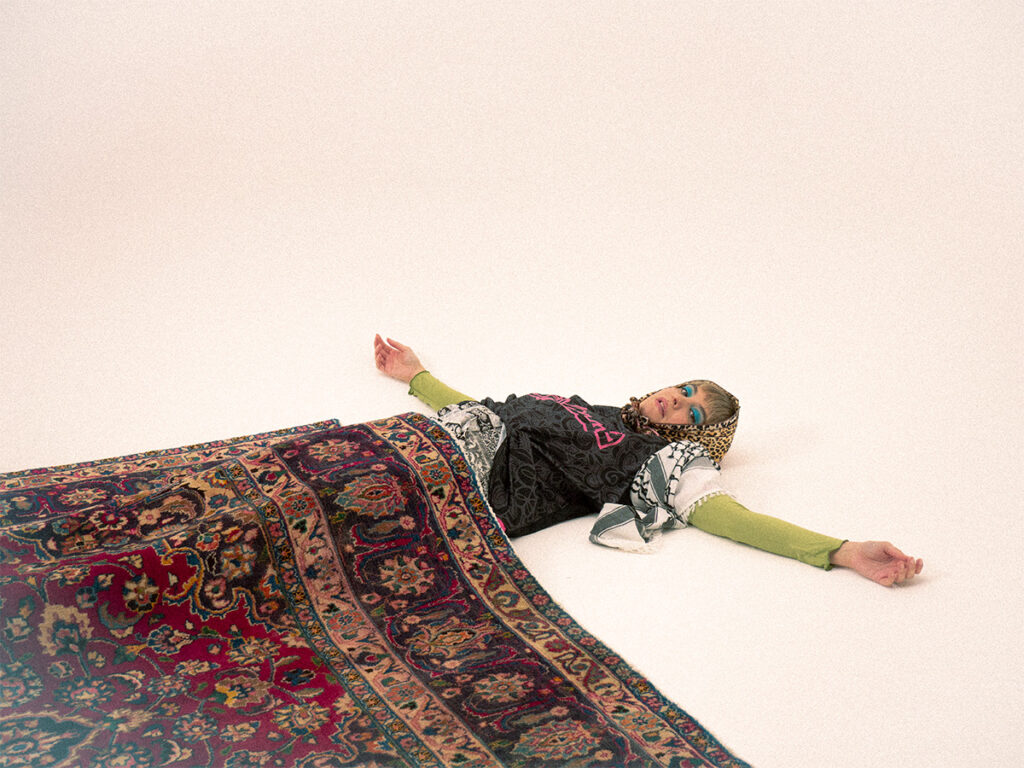
The video is well worth watching. I was truly mesmerised by its seemingly bizarre and peculiar character. I am fascinated by the notion that you spent some time with actual goats to learn their mannerisms and perspective. What’s the reasoning behind such radical embodiment?
Ah, thank you! I suppose it’s not that radical to actors and performers, as animal work was a huge part of my training at Drama Centre. So when taking on this concept, it felt natural for me to dive back into my training and research, using Laban techniques as well as journaling throughout the process. My high school theatre teacher, Jim McLean, whom I met in Beirut, also mentored me through it by refreshing my movement knowledge and being incredibly supportive and encouraging.
I focused on one goat in particular, named Chewy, because we were roughly the same size, and she had this aloof, graceful quality while still feeling incredibly powerful. I think it’s important to work from one specific animal because every animal has its own personality, rhythms, and quirks. If you try to generalise, the portrayal can become too broad or performative. Focusing on one animal creates a level of authenticity and specificity that makes the physicality feel much more truthful.
Lastly, what’s next for Salwa? Are you performing any live shows in the near future?
The visualiser is dropping on the 5th of June, and I’m currently curating a series of live shows to accompany it. I’m also working on my second album with co-producer Spiros Muas, so there’ll be new tracks and visualisers released throughout the next year or so.
I’m also part of a quirky indie band with my fiancé, King Katsuu, called misty4me. We’re currently working on our first EP, and we’ve already released a single called ‘coffee fund’, with a video for that coming soon too.
I feel really blessed. A lot is happening creatively right now, and I’m lucky to be constantly surrounded by music and ideas!