


‘GOODGrief’ does exactly what it says on the tin, turning painful and confusing grief into a mighty (and good) body of artistic work, a striking musical exploration into the human mind, an introspective journey into unrequited love and romantic breakups. At the helm of such a powerful and meaningful record, we find Asheville-based creative K A T R I N A, whose latest EP picks up exactly where she left off in 2025 with the highly celebrated single ‘BETCHUTHINKYOURESPECIAL’.
A bold and loud dark-pop cut, the aforementioned single doesn’t necessarily define ‘GOODGrief’ either. It is simply its loudest component. Elsewhere in the EP, K A T R I N A gets comfortable in evocative soul-pop settings (‘Different Life’), or funk-flavoured explorations (‘Breathe’). It’s a sign of the incredible eclecticism shared by the American artist, able to adapt to a variety of moods and genres. Ultimately, it’s also evidence of a keen, nuanced musicianship; her technical prowess is second to none.
There’s a lot to uncover about ‘GOODGrief’, and we’ll do so with the help of K A T R I N A herself. Intrigued by such potent artistry, we caught up with the talented creative to learn more about the record and her personal background. Interview below!
Hi K A T R I N A, thanks for chatting with us! I have spent some time listening to ‘GOODGrief’, and I certainly appreciate its thematic, meaningful ethos and its gentle sonic eclecticism.
You seem adamant about “turning heartbreak into therapy on the dance floor”, a phrase that has perhaps become a functional slogan for the whole project. Is that something you truly believe in? Do you see music and artistic expression as a cathartic tool for processing our complex emotions?
I truly believe in it. I don’t think heartbreak is something we “get over.” I think we metabolise it. And music is one of the few tools that helps us do that without numbing out. It lets us feel it, but move through it. Countless albums have been soundtracks to my life over the years.
When I say “turning heartbreak into therapy on the dance floor”, I mean transforming heavy emotion into movement. Into power. Into release. You can cry to a song, but you can also sway to it. You can reclaim it. That’s catharsis to me.
Art is how I process everything. If I don’t write it, it sits in my body. When I do write it, it becomes shared. And once it’s shared, it becomes less isolating. That’s the magic.

The reader might not know this, but apart from your shiny artistic moniker, you are a very experienced performer and creative, with over 15 years spent refining your craft. Taking a cue from the previous question, do you believe that choosing music and art has allowed you to become a better person? Would you say you are living an authentic life, one that’s true to your inner self?
Absolutely. At the very least, it’s made me reflect upon who I am as a person.
Music has forced me to be honest with myself. It has made me sit with uncomfortable truths instead of avoiding them. It has made me braver in relationships, braver in leaving, braver in staying, braver in speaking. Most of all, it humbled me to my own psyche. I think as artists we are sensitive humans to begin with, but sometimes we feel things sonically before we even process them mentally. It really is a way to hold a mirror to yourself.
I do feel like I’m living authentically now. For a long time, I performed, but I wasn’t fully integrated and limited myself with excuses. K A T R I N A is the integration. She’s the version of me that stopped trying to be palatable and started being truthful.
Choosing music wasn’t just a career path. It was choosing alignment.
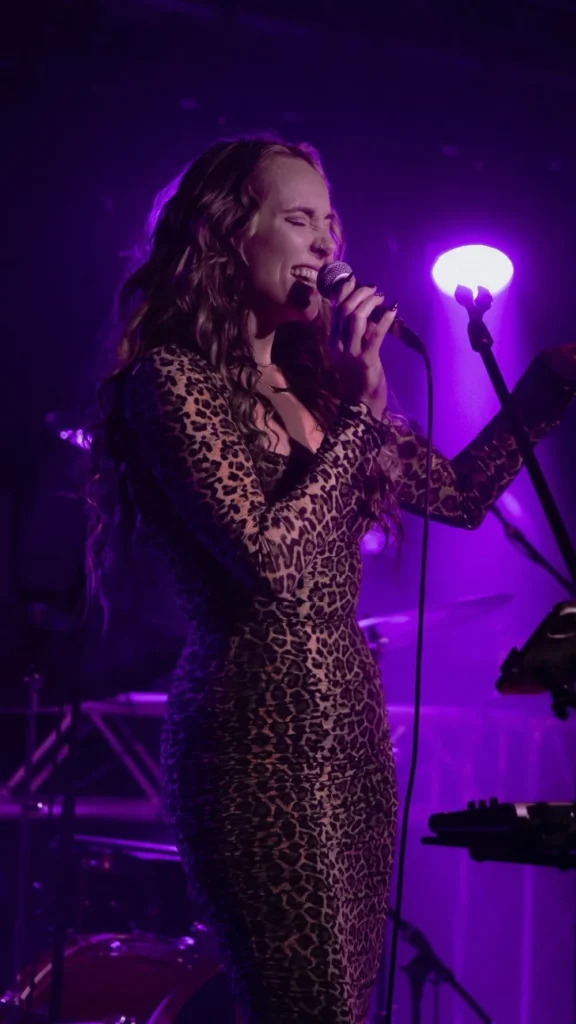
Before we dive deeper into ‘GOODGrief’, I’d like to know more about your upbringing. What first motivated you to step into music-making? Was there any crucial influence that made that possible? What were some of your favourite artists growing up?
I’ve been performing since I was a kid. Family cookouts, talent shows, weddings. I used to stand on a cooler in the backyard and sing like it was Madison Square Garden. Luckily, it was before the digital era, so those photos are nice keepsakes I will have forever.
I grew up on Luther Vandross, Donna Summer, and Sade. Later, it was Christina Aguilera, Paramore, Alicia Keys. In college, I fell hard for Frank Ocean, Alina Baraz, D’Angelo, Lana Del Rey, Lorde. Nowadays, I love the expansiveness of music and integration of all the new sounds like Dijon, Willow, BANKS, SG Lewis, JUNGLE, Olivia Dean, etc.
There wasn’t one moment where I ‘decided’. Music was always there. But I was raised by an Irish immigrant mom who worked incredibly hard to build a life for us in America, and I internalised that. I felt like I needed to be practical first. So social work came first. I wanted stability. I wanted to understand people, pain, and resilience in a real way.
Then life started stacking moments that shifted everything. When I was 25, my dad went into a coma. He survived, but it rewired my sense of time. After that, I quit and threw myself into music full-time. Almost immediately, a music teaching job landed on my doorstep. Then my nine-year relationship ended. Then a big move. Then I pursued a master’s in research science.
It was like I kept building tools without fully knowing why.
Then Bluz Bill (a local music supporter) sponsored me to go on Jam Cruise. Being surrounded by these musicians, watching what original music does to a room, feeling that emotional shift in real time, it woke something back up in me. After another heartbreak, it was the final domino.
BOOM.
I remember thinking, what am I waiting for? If they can do this, I can do this too.
Fast forward to today, and Katrina has become K A T R I N A, quite possibly your most powerful endeavour to date. ‘GOODGrief’, your latest EP, is out now, and I am fully intrigued by its deep eclecticism. The record navigates diverse influences, from the evocative R&B elegance of ‘Different Life’, to the dark-pop allure of ‘BETCHUTHINKYOURESPECIAL’, passing through the funk-flavoured soulful goodness found in ‘Breathe’.
From a sonic standpoint, how do you orient yourselves towards a specific mood/vibe? Is there a particular thought process behind it? Do you thrive in such heightened eclecticism?
For me, emotion is the palette, and the song is the painting. Once you’ve made a few paintings, you start to see the gallery they belong in, the bigger concept that ties them together. A friend heard my first few demos and said, ‘It sounds like you’re grieving’. I was (lol). And that’s how ‘GOODGrief’ became the gallery aesthetic.
A lot of the industry pressure is about fitting into a box, but the artists who have lasted the test of time have always stood outside of it. They learn the craft from the greats, then translate their own inner world. That’s how I work too. Genre bends to serve the emotion.
If a song feels like anger, it might lean darker, more percussive, more angular. If it feels like surrender, it gets softer, more spacious, more atmospheric. I don’t start with ‘I want to make an R&B song’ or ‘I want to make a pop song’. I start with, ‘What does this emotion feel like in my body?’
Eclecticism feels natural to me because emotions aren’t one-dimensional. GOODGrief moves the way grief moves. It shifts, contradicts itself, surprises you, and still somehow makes sense when you take it all in together.
Likewise, the EP’s lyrical landscape shifts as dramatically as its production. Is there an overarching concept that propels it all?
Yes. ‘GOODGrief’ is structured around the five stages of grief applied to modern heartbreak.
Denial. Anger. Bargaining. Depression. Acceptance.
But the twist is that the final track, ‘Different Life (Afterglow)’, revisits the same lyrics from the depression stage with a new melody and production. Because grief doesn’t disappear when you accept it. You just carry it differently.
The entire EP is a narrative arc. It’s cinematic by design.
Widening the creative picture, what’s your writing process like? Do you write with a certain idea in mind, or do you allow yourself to wander freely, wherever inspiration might take you? Is it a solitary effort?
It’s intuitive first, intentional second.
Sometimes I start with a lyric that won’t leave me alone. Sometimes it’s a chord progression. Sometimes it’s a beat that triggers a memory. I let myself wander at the beginning. That’s where honesty lives. Some of it is garbage, but hey, one man’s trash is another man’s treasure, right? There are always gems in the voice memos, and I pick them out.
After that, I get structured. I care a lot about cohesion, syllables, and emotional pacing. It becomes architectural.
I do write a lot alone, but I love collaborating when the energy is aligned. About halfway through my process, I found Mannyfesto and Alex Goforth, and the two of them have been incredible co-producers and collaborators. The key for me is emotional safety. If I feel safe, I can go deep.

There’s a series of upcoming releases that will make 2026 a crucial year for K A T R I N A. Is the overall vibe going into a fierce, bolder direction or a more introspective, melancholic one? What can we expect from it?
2026 is ‘The Anatomy of Goodbyes’, a year-long concept project that walks you through true healing and transformation in real time.
‘GOODGrief’ was about processing what happened. What’s coming next is integration and reclaimed power. It’s bolder sonically, more rhythm-forward, more confident, more cheeky, as I like to say. There’s still emotional depth, but the perspective shifts from ‘Why did this happen to me?’ to ‘I’m ready to go back out there and conquer the world’.
This next EP, ‘The Antithesis’, hits the realities of dating in 2026: the oddities, the culture of it, the fragile confidence we all carry, and the way you can think you’re ready until you’re actually in it again. Sometimes healing isn’t a straight line. Sometimes you discover the bruise is still tender when you least expect it.
You can expect growth from me. A lot of ‘GOODGrief’ was written and recorded about a year ago, and since then I’ve poured thousands of hours into my craft: learning, writing, rehearsing, refining. So naturally I’ve evolved, and so has the sound. More collaboration in composition, stronger vocal hooks, more dance-floor energy. Still cinematic, still honest, but less wounded and more shoulders back, head up.
Lastly, are there any plans for live shows, perhaps around your home base of Asheville, NC?
Yes. Live performance is where everything becomes real.
Asheville has been an important home base for me, and I’ve learned so much from so many talented musicians here. At the same time, my specific sonic lane, alt-R&B pop with dance-forward production, is a little harder to find locally, so I’ve been travelling a lot to record. I frequently fly to St. Petersburg to work with Alex Goforth at Goforth Studios, and that collaboration has become a big part of my sound.
This spring, I’m actually making a move to St. Petersburg when my lease is up. I want to be closer to that community and put myself in the middle of the alt-R&B and pop-dance scene so I can create at a higher level and more consistently.
In the meantime, I have a few upcoming local shows, and I’m planning one last original show in Asheville in April. I want it to mirror the emotional arc of the EP, so it feels immersive, not just a setlist.