


One could describe ‘Aphrodite Leaves’ in many ways, but a feature that’s been particularly striking is its ability to completely hypnotise listeners, truly engulfing them in an ever-growing emotional whirlwind, a complex aural continuum that feels cinematic, intense, and urgent. Everything here is worth pointing out: from the nuanced lyrical premise to the complex, layered orchestral arrangements. Expansive and lush, ‘Aphrodite Leaves’ is evidence of Chloe Dunn’s commitment to her craft.
For the uninitiated, Dunn is a very, very talented multi-instrumentalist and composer, English-born and now based in France. We have already reviewed some of her past material, and we are not yet tired of it; it’s just so heartfelt and raw, a musical concoction able to awaken even the most apathetic of listeners out there. As its title implies, ‘Aphrodite Leaves’ contains a rather witty reference to Greek mythology, as Dunn seeks to reclaim some of the narratives in them, giving them an empowering modern-day shine.
Intrigued by the piece, we caught up with Chloe Dunn to really get a glimpse of her artistry, where she’s coming from, and what keeps her moving forward. It’s always inspiring to hear about people’s life experiences. Interview below!
Hey Chloe, thanks for chatting with us! This interview arrives on the back of a feature we published last year, praising ‘Blossom’ EP as “timeless vocals and poignant strings… a tapestry of soft electronic tones”. It must have taken a fair amount of practice and education to arrive at such aural heights. I’d be curious to know more about your journey in music. Is there an academic path somewhere in your past?
Hi Gabriel, it’s a pleasure to chat with you. Your article about my EP brought about a profound identity shift for me. Reading such beautiful and evocative words about my work, written by a then-stranger, shifted my perception of myself from ‘musician who writes a bit’, to ‘composer’. This is one of the superpowers of music journalism. So, from my heart to yours, thank you. Because now, my aching desire is finally materialising.
In terms of my musical trajectory, I played a lot of symphonic and folk music growing up. I bathed in it: concerts, classical violin training, ensemble playing, and a lot of listening at festivals, etc. I have my parents to thank for this. But I didn’t do music at university. My learning was mostly acquired through listening and playing.
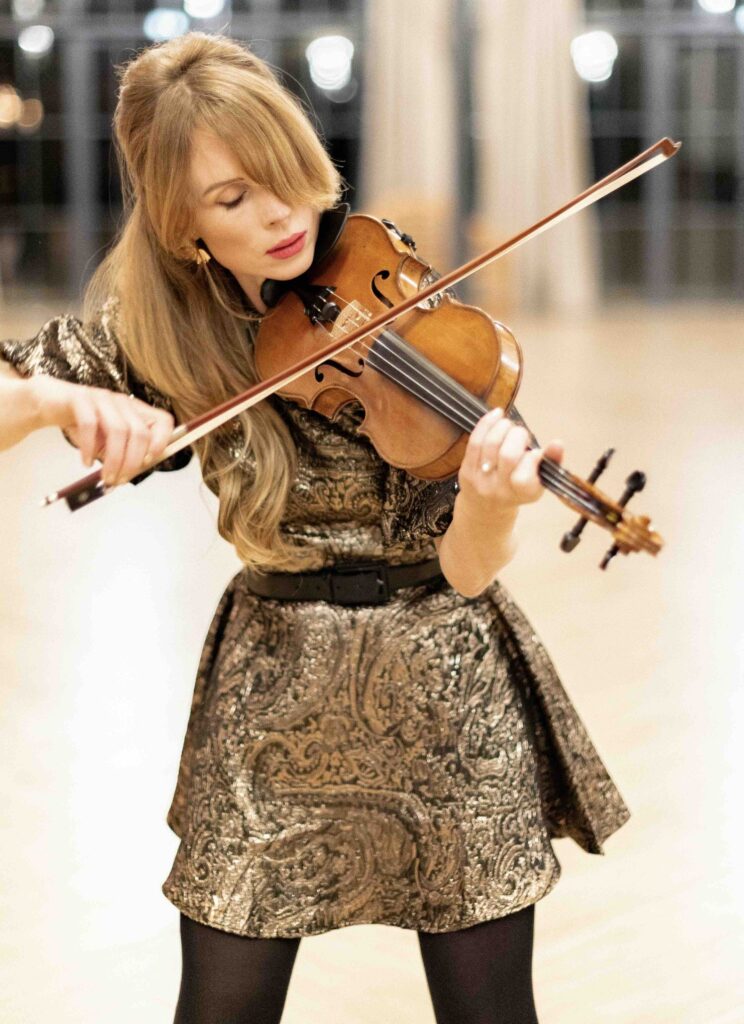
Looking back, is there anything specific that motivated you to become a musician and a performer? Likewise, are there any particular artists who have played a pivotal role in your development?
I have been inspired and guided by witnessing artists who transcend their body and mind through music; those who bring true presence, awareness, and non-ego lead sharing to their performances and compositions. Two examples that spring to mind are Estonian composer Arvo Part and English folk musician Chris Wood.
‘Aphrodite Leaves’ is your latest single, another example of your signature layered arrangements, gentle and nuanced, yet also expansive and lush. I love how you let yourself be inspired by Greek mythology, a topic that seems to be almost forgotten nowadays, at least outside of schools. Coincidentally, there’s a big Odysseus-themed blockbuster coming later this year… that aside, I’d love to know more about your knowledge of Greek mythology; in the song, you give it a rather modern twist, am I right?
I didn’t know that, I’ll look out for the film. I have been deeply inspired by the podcast Tales of the Night Sky. It’s a unique audio drama, inspired by Greek and Roman myths. I recently created the music for an episode about the Argo, which featured Aphrodite. Taking the short leitmotif that I had created for Aphrodite, I then expanded it into a song. When working on the lyrics, a re-telling of the Apple of Discord story came through, where Aphrodite loses interest in gaining validation from Paris, thus finding freedom (and, let’s assume, avoiding the Trojan War altogether).
As you just mentioned, your record sees Aphrodite reclaiming her power and independence, recentering her self-worth around internal conscience, rather than external validation. Do you have a particular connection with this idea? Does it speak to you on a personal level, perhaps based on past experiences?
100%. The worst thing about toxic beauty standards is that they sap women of their creative energy. I certainly lost mine for a long while.
‘Aphrodite Leaves’ builds on the previous success of ‘Blossom’. In comparison, the new record feels a tad more melancholic and sacred, certainly exhibiting a heightened cinematic allure. There’s more gravitas, a keen sense of urgency meeting listeners with trepidation and slow-burning euphoria. Did your compositional approach change on purpose, or are you mostly adapting to the song’s subject matter?
That’s really interesting feedback, especially from someone like you with such a keen ear, and who knows my music. I think I was in quite a melancholic phase when I composed it. I hold a lot of drama in my soul, underneath that English reserve! My début EP opened the floodgates; it helped me let go of any self-consciousness around releasing my music. Which then had the knock-on effect of releasing even more personal truths into my music.
You are also a talented producer and handle all of your recordings. Can you take us through the logistics of that? Do you have a studio space you work from? Is there a specific process you like to follow? Do you have a preferred starting point between lyrics and melodies?
I love working through the whole process on my own. There is a room in my house devoted to violin practise, composition and recording. It’s not particularly beautiful, but it has this one marvellous thing: a door. Closing it opens a world of creativity. I need to be in my bubble to write.
To begin, I usually start improvising, and then hit record on the looper when a good idea comes through. Then harmonies and motifs emerge from the layering of different ideas. I let the loop play on, and the repetition gets me into a trance. The vocal line then starts to emerge, and I record everything into my dictaphone. The seed lives in my headphones for a few days, as I listen back and flesh out the lyrics and themes. My favourite place to write lyrics is on the train. Then the recording and editing process begins.
Is there a bigger picture behind ‘Aphrodite Leaves’? Can we expect more like-minded releases later this year?
Yes! I’m currently working on the next song. It’s very different: sparse and quite raw. I would like to release an album in autumn, but at my current rate (two months per song), there won’t be enough material, so I need to step up the pace.
Lastly, you are currently based in France, just a stone’s throw from your British homeland. Is the musical landscape different in comparison with the UK? I heard a rumour that French musicians particularly excel on a technical level…
In France, there are fewer dilettantes, for better or for worse. To my mind, it’s because of the conservatoire system. Basically, the only way to learn ‘serious’ music is to pair it with a theoretical curriculum. In my opinion, the system intellectualises music too soon. And music remains an elitist activity. Whereas in the UK, my experience of music learning was much more personalised and ensemble-based, thus instinctual and joyful, as it should be.