


The listening experience behind ‘Short & Fleeting Life’ is incredibly meaningful and intimate, a slice of heartfelt poignancy delivered by the creative mind of Danish singer-songwriter Joakim Lykke. Teaming up with fellow troubadour CFB (Claus Flindt Bjerg), Lykke writes about the painful end of a friendship with restraint and purpose, eventually touching on some of life’s most pivotal challenges: trust and vulnerability.
CFB lends his vocals to Joakim’s cause, drawing from his own experience with PTSD following active duty in the military. While the two artists approach the song from different angles, the result is the same, as they search for an answer and a hopeful resolution. Tinged with nostalgic and melancholic flair, ‘Short & Fleeting Life’ is a wonderful offering.
Intrigued by Joakim Lykke and his longstanding career as a wholesome, dedicated songwriter, we caught up with him to learn more about his artistry and records… Interview below!
Hi Joakim, thanks for chatting with us! How are you doing in our chaotic times? The world burns, and here we are, discussing music and art… 🙂
Well, first of all, thanks for having me! And yes, the world does seem to be doing a pretty good job of setting itself on fire these days, right? But maybe that’s exactly why we should be talking about music and art. I think we’re living in a time where everything is moving incredibly fast. We’re constantly bombarded with news, opinions, conflicts, and people telling us what to think and how to feel. And sometimes I think we forget to actually stop and feel something for ourselves.
Interestingly… that’s also very much what my most recent single, “Let Me Know”, is about. The song was inspired by my frustration with a world where people in positions of power make decisions that affect millions of lives, often without appearing to take responsibility for the consequences. But although the inspiration came from politics, war, and the injustices we see around us, I don’t really consider it a political song. To me, it’s about something much more fundamental: trust, responsibility, and the need to feel that the trust we place in other people, institutions, or systems is actually being respected. I think that’s something we can all relate to, whether we’re talking about world leaders or the people closest to us.
That’s one of the things I love most about music and writing songs. It gives us a chance to disconnect from all the noise for a moment and reconnect with something human. So, how am I doing? Well, I’m doing pretty well, actually. I’m writing songs, playing music, spending time with my family, and trying to make sense of the world like everybody else. And when the world gets a little too chaotic, I usually pick up my guitar. Not that it solves everything, but it helps!
Before we dive deeper into your music, I’d love to know more about the human behind the record. Has music always been part of your life? Is there anyone or anything that has played a pivotal role in your artistic development?
Music has always been a big part of my life, although it took me quite a while to realise that I wanted to create my own. I’m very much a child of the ’90s, and a lot of the music coming out of the US during those years had a huge influence on me. Bands like Counting Crows, particularly Adam Duritz and his songwriting, Matchbox Twenty and Rob Thomas, and especially the band LIVE, which had a tremendous impact on me. In more recent years, I’ve become a huge admirer of the Australian band Gang of Youths.
I think what connects all these artists is their ability to write about things that really matter to them. Injustice, personal frustration, human relationships, and the complicated ways we interact with each other and ourselves. Not necessarily romantic relationships, but the relationships that shape us as people.
When I look at my own songwriting, I realise that those are exactly the subjects I keep returning to. I’ve always been drawn to artists who have something to say. Not necessarily the greatest singers or the most technically impressive musicians, but people who can make you believe every word they’re singing. For many years, I was mostly playing other people’s songs. And I loved doing that. But somewhere along the way, I started feeling that I had stories of my own that I wanted to tell.
The first song I ever wrote, and dared to perform in front of an audience, was “Grade-School Lover” back in 2004. And I think that was a pretty significant moment for me – suddenly, I wasn’t just interpreting somebody else’s words. I was putting something of myself out there, which was quite a vulnerable thing to do. Over the years, I’ve realised that storytelling is probably the most important part of what I do. I’ve played more than 600 concerts, and some of the most memorable moments haven’t necessarily been about the music itself, but about the connection that happens between a song, a story, and the people listening. I think that’s what keeps me going.
From a lyrical standpoint, ‘Short & Fleeting Life’ is inspired by a rather painful experience you endured in the past. Can you expand on that? What are some of the lessons you have taken away from all that has happened?
The song came from a period in my life when someone I considered a very close friend turned out to be someone entirely different from the person I thought I knew. We had worked together for several years, spent time together outside work, and our families had become close. He was someone I trusted completely. But then I discovered that he had been involved in some very serious dishonesty and deception through his business. And suddenly, everything I thought I knew about him was turned upside down.
But here’s the thing… The hardest part wasn’t actually losing the friendship. It was losing confidence in my own judgment. I kept asking myself how I could have been so wrong about someone. Had I been naive? Were there signs I should have noticed? Could I even trust my own instincts anymore? And that really affected me.
I think one of the biggest lessons I’ve taken away from that experience is that trusting someone isn’t necessarily a sign of naivety or weakness. We have to be able to trust people. Otherwise, we can’t really build meaningful relationships. But I’ve also learned that when someone betrays your trust, you have to be careful not to let their actions define how you see yourself. Which is easier said than done, of course. And perhaps that’s exactly why I ended up writing a song about it.
I always find that heavy emotions, whether positive or negative, give birth to great art. In the case of ‘Short & Fleeting Life’, do you think that writing the song helped you accept what happened? Would you agree that it functions as a cathartic tool for moving on?
Absolutely. Although I’m not sure I was consciously trying to achieve that when I wrote it. For me, songwriting has always been a way of processing things I don’t necessarily understand. My process is probably a little unconventional: quite often, I write the lyrics long before I have any music or melody in mind. Sometimes what I write isn’t even structured like a traditional song. It might just be a rant, a collection of thoughts, or me trying to get some frustration out of my head.
In fact, I have hundreds of unfinished lyrics lying around that may never actually become songs. And that’s perfectly fine with me, because sometimes the writing itself is what I need. Later, when I’m sitting with my guitar and come up with a melody or a musical idea, I’ll often go back through those texts and see if there’s something that fits. Sometimes there is. Sometimes there isn’t. But I think that’s one of the fascinating things about writing songs. You can discover something about yourself in the process.
With “Short & Fleeting Life”, I think I was trying to make sense of what had happened and, perhaps even more importantly, how it had affected me. But I don’t think writing a song automatically makes everything better. It’s not like you write three verses and a chorus, and suddenly all your problems disappear! What it can do, though, is help you put some distance between yourself and the experience. You take something that’s been living inside your head, something that might be difficult to explain, and you turn it into something tangible. And sometimes that makes it a little easier to live with.
So yes, I definitely see songwriting as a kind of therapy. Not necessarily a cure, but a way of understanding and accepting things.

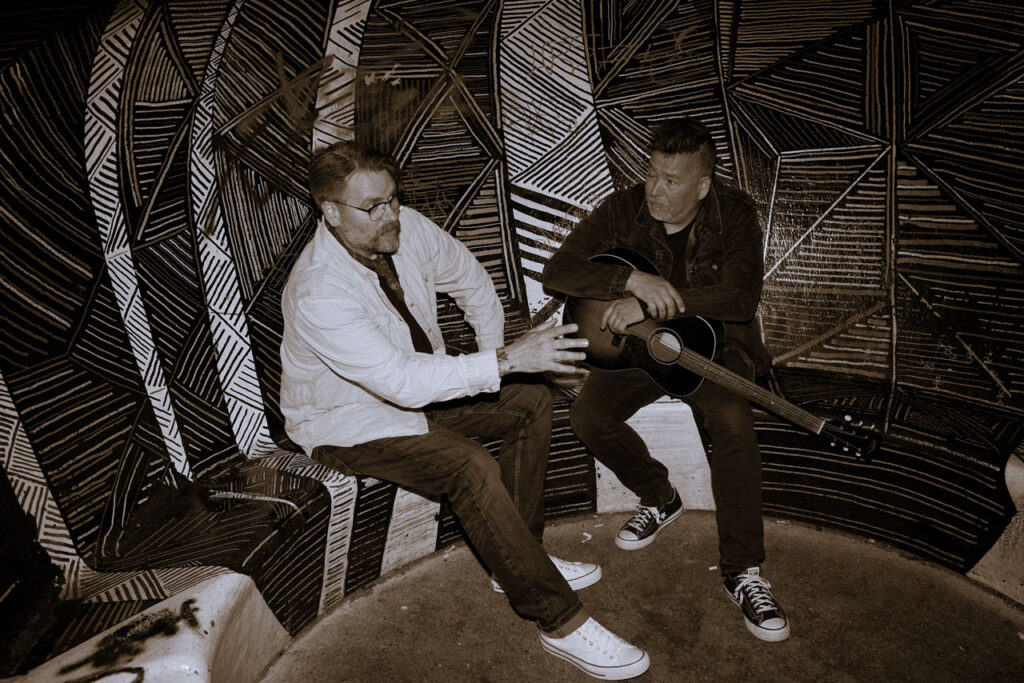
Claus Flindt Bjerg (CFB) is a featured guest on the song; how did you two meet? What made you think that he’d be a perfect match for the record?
Claus and I actually met about 10 or 12 years ago through a mutual friend who is a singer-songwriter in a band called The Devil’s Tiny Chains. At the time, Claus was the frontman of a country band called SuperScum, and the two bands were collaborating on a single. That’s how we first got to know each other. Fast forward to the summer of 2025, when Claus and I were sitting in my kitchen, exchanging ideas and playing some of our new material for each other.
At one point, I played him a rough version of “Short & Fleeting Life”. And he connected with it almost immediately. What really caught my attention was the way he started talking about the lyrics, what he heard in them, and how they affected him. Because he wasn’t hearing the same story I had written.
Claus is a veteran soldier who has been deployed abroad, and he now lives with PTSD. He’s also the father of two young boys. For him, the song wasn’t about betrayal or losing trust in another person. It was about mortality, the people he’d lost, the experiences he’d carried home from war, and the fear of not having enough time to give his children everything he wants to give them. And that really struck me, because here was someone listening to a song I’d written about something very specific and finding an entirely different story within it. So when it came time to record the song, I got the idea of asking him if he’d like to sing on it.
To be honest, I wasn’t entirely sure our voices would work together! We have quite different vocal styles, and I had no idea whether they would complement each other. But I think it worked out great! What makes the duet special isn’t just the way our voices work together. It’s the fact that we’re singing the same words from two very different places in life. It wasn’t about finding someone who could sing a harmony. It was about finding someone who had something of his own to say through the song.
The duality between you and Claus, approaching the song from different angles, reveals something deeper about songwriting and music in general: listeners are likely to relate to the record in their own ways, projecting their own past into it. Is this something that comforts you? What would you like listeners to take away from the piece?
Yes, absolutely! In fact, I think that’s one of the most beautiful things about music. As a songwriter, I know exactly what inspired me to write a particular song. I know the people, the situations, and the emotions behind it. But the moment I release the song, it doesn’t really belong to me in the same way anymore. It becomes something that other people can interpret through their own experiences. And I love that!
I don’t necessarily want people to hear my story when they listen to my music. But I hope they can find something that makes sense in their own lives. And Claus is the perfect example of that. He heard something in “Short & Fleeting Life” that I hadn’t consciously put there myself. And yet, it was absolutely real to him. If someone listens to a song I’ve written and they find comfort, recognition, or simply a feeling that they’re not alone in whatever they’re dealing with, then I think the song has accomplished something important. I don’t need them to understand what I meant. I just hope it means something to them.
Take us into your creative process: do you usually prefer to write music alone or with others? What about the production side of things?
Most of my songwriting happens when I’m alone, and quite often, it doesn’t even begin with music. As I mentioned earlier, I tend to write a lot of lyrics, thoughts, and ideas long before there’s a melody attached to them. I guess writing is my way of clearing my head. When I’m sitting with my acoustic guitar and something interesting starts happening musically, I’ll often go back to those texts and see if I can bring the words and music together.
It’s not always an easy process, because the words weren’t necessarily written with a particular rhythm or structure in mind. So sometimes I have to reshape things quite a bit to make them work as a song. But I actually enjoy that process. I think I need the freedom to explore an idea on my own without having to explain it to anyone else before I fully understand it myself. When it comes to production, though, I really enjoy collaborating with other musicians. I think there’s something important about allowing other people to bring their own creativity into a song.
For “Short & Fleeting Life”, I worked with producer Lucas Illanes at The Hideout Studio. Lucas has a great ability to understand the emotional direction of a song and translate that into musical choices. He played both the electric guitar and the piano on the recording, and I think those two instruments create a really interesting contrast. The guitar brings out some of the frustration and tension, while the piano, which runs throughout the song, creates this almost empty space where you’re left alone with your thoughts.
I think the best collaborations happen when you trust the people you’re working with enough to let them surprise you. Which, when I think about it, seems somewhat appropriate to say about a song that started with a betrayal of trust!
Lastly, what’s next for Joakim Lykke? Any new release or live show on the horizon?
Well, 2026 has actually been a pretty busy year for me! I decided to release five singles throughout the year, beginning with “Grade-School Lover” in April, followed by “Short & Fleeting Life” in June, “Someday” in August, and my latest release “Let Me Know”, in October. And there’s still one more to come. On December 17, I’ll be releasing “I Wasn’t Done With You Yet”, which will be the fifth and final single of 2026.
Alongside the releases, I’m continuing to perform live, focusing on concert formats that bring music and storytelling closer together. I’ve always believed that the stories behind the songs are an important part of the experience, and that’s something I want to explore even further. So there are definitely more concerts, more stories, and more music on the way. And hopefully, a few more things I haven’t even thought of yet!