

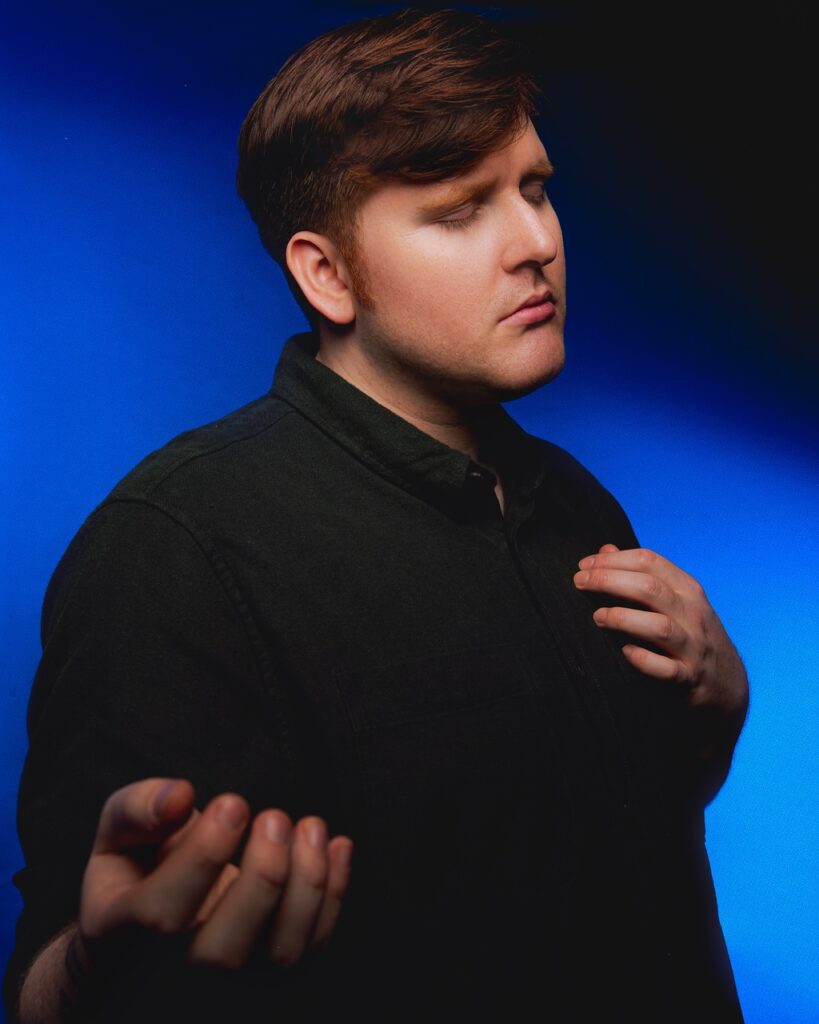
An expert singer, songwriter, musician and educator, Sacha Mullin enjoys a multi-layered career that takes him into original territories as well as various supporting roles. In this article, we’ll focus on his own music, particularly on Mullin’s latest album ‘Social Touch’. Out now, the record sees the Chicago-based talent move into a poppier direction, yet still applying the eclectic and kaleidoscopic character he is known for.
Tinged with soulful episodes, jazz forays and rock-leaning guitars, ‘Social Touch’ represents a great insight into Mullin’s extensive musicianship. His vocals are unmatched, sporting a clear, malleable tone that cuts through any aural setting. Sacha’s tone control is nuanced and elegant, able to shift from gritty intensity to soft tenderness at a moment’s notice. ‘Bed All Day’, the latest single to be extracted from ‘Social Touch’, is a quirky example of contemporary pop.
Intrigued by Mullin’s wide-ranging artistry, we caught up with him to learn more about his journey in music… Interview below!
Hey Sacha, thanks for chatting with us! Let’s dive right into your latest album, Social Touch. First of all, congratulations on the new release; compared to some of your previous material, I get the sense that you are moving into poppier territories, yet still keeping the gentle eclecticism that has characterised your journey so far. Are you proud of how the album turned out? How long has it been in the works?
Hi! Thanks so much for having me! I’m thrilled with the results, truly. I had two main missions in mind when making the record: 1) How can I wield pop influences in various forms as a tool for exploring worlds while letting people in? And 2) how can I do that in a way that respects what I’m pulling from while still sounding like myself?
It’s actually the fastest turnaround for a record I’ve made. I took a small break after Casino Wilderness Period came out, and amazingly enough, Social Touch was a breeze to make. It was finished in August 2025, so the wait has really just been about production times and other boring behind-the-scenes necessities. But I could just as easily answer “how long has this been in the works?” with “this sort of record finally came to me at the right time.” So maybe my whole career!
I know that there are some cool people involved in the record; would you like to shout out some of them?
For sure! William Parker Wood produced this project. He’s known locally in Chicago for playing in several groups, including Power Pup, Hex Toy, and Vamos. We’d been floating around some of the same circles for a while, and something in my bones told me to ask if he’d want to try recording together. The experience was so easy and inspiring that it quickly developed into a full album’s worth of songs.
I also brought in Sarah Johnson, who’s also in Hex Toy, to sing some supporting vocals on the closing track, “Odd Radio Circle,” and the equally incredible Emily Bindiger was kind enough to return for “Hypocenter.” Both of them sing with such kindness and passion. The songs really came to life with their support.
There’s also my label, which has stood by me and my shapeshifting, so a shoutout to Kevin and Lisa from Dipterid!
From a lyrical perspective, what does the album mean to you? Of course, its ten tracks span a variety of themes, but is there an overarching ethos? What should the listener take away from it?
I think lyrically, I’m trying to write as myself, which is admittedly a little funny because I’m clearly cognizant of the Mariah Carey, PhD-level thesaurus happening in my words. But it really is just how I talk and form ideas.
When I stood back from the whole thing, it became obvious to me that the song “Social Touch” had to become the title track. Taken together, the songs started to reveal an underlying longing to be understood. I’ve struggled my whole life with feeling excluded and/or misconstrued, intentionally or otherwise, and I think, as I alluded to before, the real pull for me here was to write music that could draw people in more immediately without compromising who I really am. And I’d argue that this is particularly important when I’m branded in my solo work under my own name, because my output is inexorably linked to the “real” me.
Guide us into your creative process; do you prefer writing alone or with others? How does a Sacha Mullin songwriting session usually work?
In the past, I’d written a lot of material in advance, getting it as fully arranged as I could before bringing it into a session. Recording can be expensive, and you also don’t want to waste anyone’s time, so having a backlog of things can be helpful.
But for this album, that really didn’t happen so much. I think only two of the songs were fully written before the sessions: “Don’t Wanna Hurt U” and “Social Touch.” Otherwise, the usual thing would be that Will would take a quick walk, I’d be left with a keyboard, and he’d come back to me going, “OK, so I suddenly wrote a whole song. Help.” You can hear that in the very opening burst of “Joy,” which actually kept most of the demo vocal.
Will and I would have all these conversations that brought me into a space of great openness, and I think I just sort of got struck with a ton of inspiration. So, by and large, the method this time around was that he’d go take a walk for a minute, I’d be consumed with a near-complete idea, he’d come back, I’d “audition” it for him, and we’d co-pilot the arrangement. It was an incredibly liberating experience, and it instilled a lot of confidence in me as a whole.
Having a look at your biography and past achievements, it’s clear that you have enjoyed a rich music career from a young age. Let’s start dissecting that for a moment; what motivated you to pursue this path in the first place? Was there anyone or anything particularly important to your music development?
You know, yes, I’m not ignorant of my several Dear Diary days, and I’m very grateful for all the opportunities I’ve had thus far. But I think the thing that really inspires me is sound and harmony. I would watch movies and television and listen to radio dramas as a kid, and be absorbed by musical stings. Those little cues might seem like something you take in subconsciously, but I was really interested in how they could influence emotion. That’s how I’m fascinated by the construction of music: by using chords and arrangements as a way to persuade a mood. I love soundtracks, so why not try to soundtrack my life, you know?
Emily was certainly important for my development and interest in music, largely just by being herself. Her voice has both power and sensitivity. As a kid, I was able to pick out when she was the session vocalist on a project, and I was consistently amazed at her ability to overdub herself into these vast choirs. I would write letters to her, and she was always kind enough to reply to my inane questions about music theory and all that.
So I’m very grateful to people like her, among many others, who saw something in me from a young age and encouraged me to keep listening to and supporting music from the background, with the hope of eventually bringing those ideas to the forefront.
The readers might not be aware that you are/have been a prolific backing singer and collaborator for a number of important names in the music space. I’d love to know if there’s a specific memory that you can share with us, perhaps a memory that holds great meaning to you?
This might not be the glamorous arena-gig story, but it holds the utmost meaning for me. I was invited to celebrate the memory of the late Margaret Dorn, who was a pivotal backing vocalist in the industry. She was the ultimate singer’s singer, and to many of us, she was a True North. Talk about wit, ability, and authenticity… She was so much more than her résumé, and her influence lives on, especially in the hearts of those who knew her. She saw so much in people, and she is so very missed.
Her passing was difficult for so many people, for so many reasons. But her celebration of life was a beautiful moment when everyone could lay down their arms and their egos and come together as communal voices, singing Handel in the style of her Downtown Messiah on a tiny New York club stage, no less. I think she really would have loved knowing that in some form, her tradition lives on.
I’d like to quickly mention your career as an educator: does it give you hope in the new generations? There are always new talents on the horizon…
I teach and coach students and clients of various ages and skill sets, and it’s a particularly great privilege and responsibility to teach children. In a position of influence, I try my best to make sure they feel excited and curious about the world, and that they feel comfortable asking as many questions about music as they can. Encouraging critical thought is so important. I think that’s just as important as nurturing their core talent.
I’m often concerned about how certain technological advances and algorithms influence the way we take in music, particularly when it comes to the psychological effects on developing minds and the recent rapid influx of AI scammers in the charts. But other aspects of technology, like improved indexing and the ability to discover new music, are wonderful.
When I ask a young student what they love about music or creating, I find hope in their answers: that singing or playing piano makes them feel excited about learning, or that they’re starting to play music with friends at school. And when a student grows up wanting to pursue music because they felt seen, that’s real success. No matter where we end up with technology or marketing standards, that very human need to connect and express ourselves is still going to be there.
Lastly, what’s next for Sacha Mullin? We know that there’s gonna be a release show tonight in Chicago; anything else we should know?
Yes! I’m actually having a bit of a whirlwind week around the release of Social Touch. The album comes out on October 19th, and I’m celebrating with a release show at Cafe Mustache in Chicago, sharing the night with Sponj and Bret Koontz, performing as Truancy Club. Bret is kicking off a tour of his own.
I’m also hoping to get out on the road myself in the coming year, playing songs from this album as well as some of my back catalogue. I’ve got a really great group of live musicians together, and I’m excited to share how we’ve been interpreting the songs and bringing them into a new setting.
I’m also honoured to be featured in Chicago Music, Seen, a new book by photographer Jim Newberry showcasing a selection of his beautiful work, including a photo from my second album, Duplex. The book comes out on October 20th.
And then on October 23rd, I’ll be singing with MaryAnne Muglia at Subterranean in Chicago. She’s assembled a small group of singers to perform harmonies from her album Try Hard and bring her brilliant songs to life, and I’m thrilled to be a part of it. I think the world of her and her music.
Beyond all that, I’m excited to see where Social Touch goes from here. I made this record with a lot of curiosity about what my music could become, and I’m looking forward to finding out where the wind takes us!