


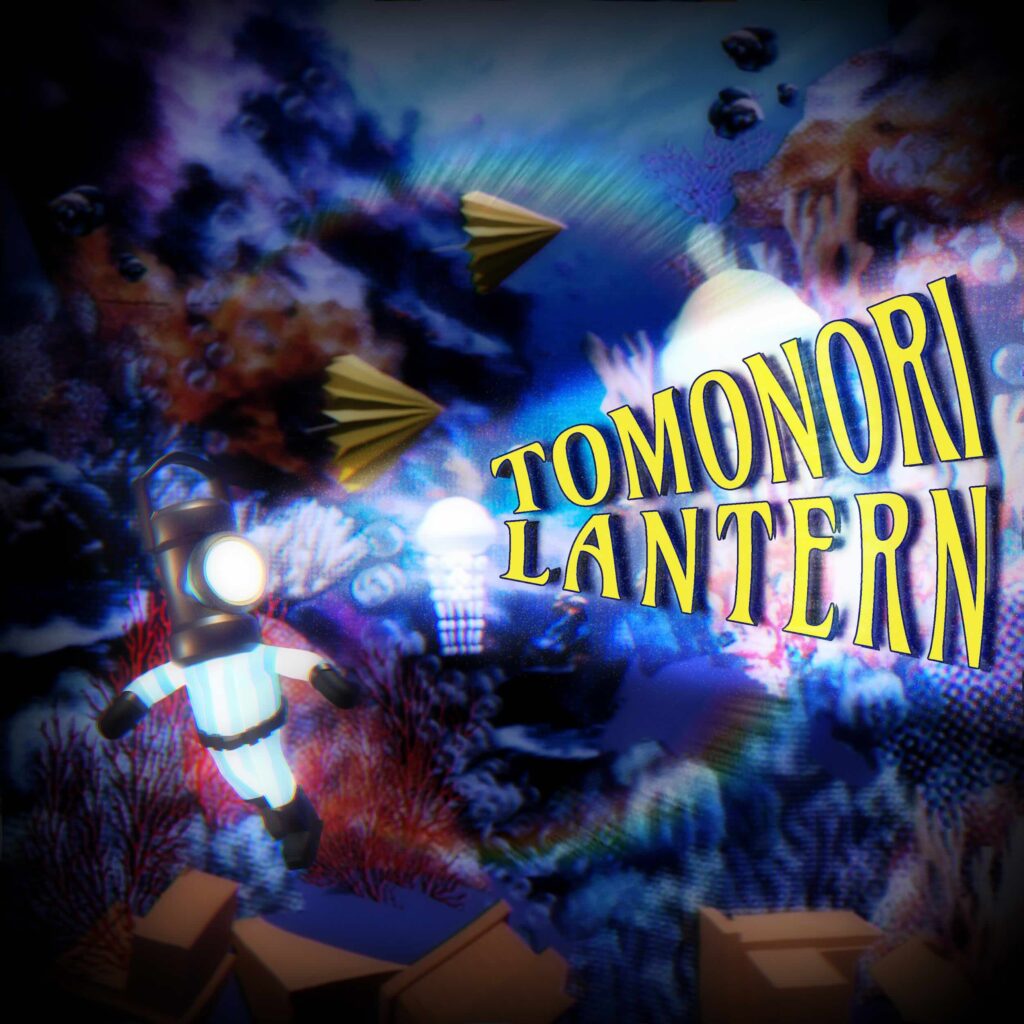
‘Lantern’ marks our point of entry into Tomonori’s artistic universe. Based in Dublin and of Japanese descent, the talented artist has gradually developed a musical identity that’s incredibly eclectic and wondrous, a blend of pop, indie and electronica with a strong leftfield allure. Whichever way you look at it, it’s hard not to admire Tomonori for his artistic courage and bold sonic prowess; he’s not doing what others do, refraining from walking the beaten path. Instead, he’s carving out his own way, a quality that’s rather important in an increasingly uniform music industry.
As mentioned, ‘Lantern’ provides a fitting introduction to Tomonori. Drawing influences from Afrobeat and electronica, the piece showcases Tomonori at his best, a slice of bright, uplifting and euphoric goodness with captivating lyricism. Co-produced with platinum-selling French producer YDTHXGRT, ‘Lantern’ is taken from the overarching album ‘Hypernonchalant’, also out now.
Intrigued by Tomonori, we caught up with him to learn more about his artistry and future goals… interview below!
Hey Tomonori, Thanks for chatting with us! 🙂 There’s a lot to cover, specifically around your latest album ‘Hypernonchalant’. Before we get there, though, I’d love to know more about the human behind the music. What is Tomonori up to when not making art?
I work in a company by day, and I also support my local community. That said, I fundamentally consider making art my life’s work, so I suppose I’m constantly ‘working’ in some sense, and I love that. While it might sound a bit workaholic, my favourite time is simply enjoying my day-to-day life and resting every day.
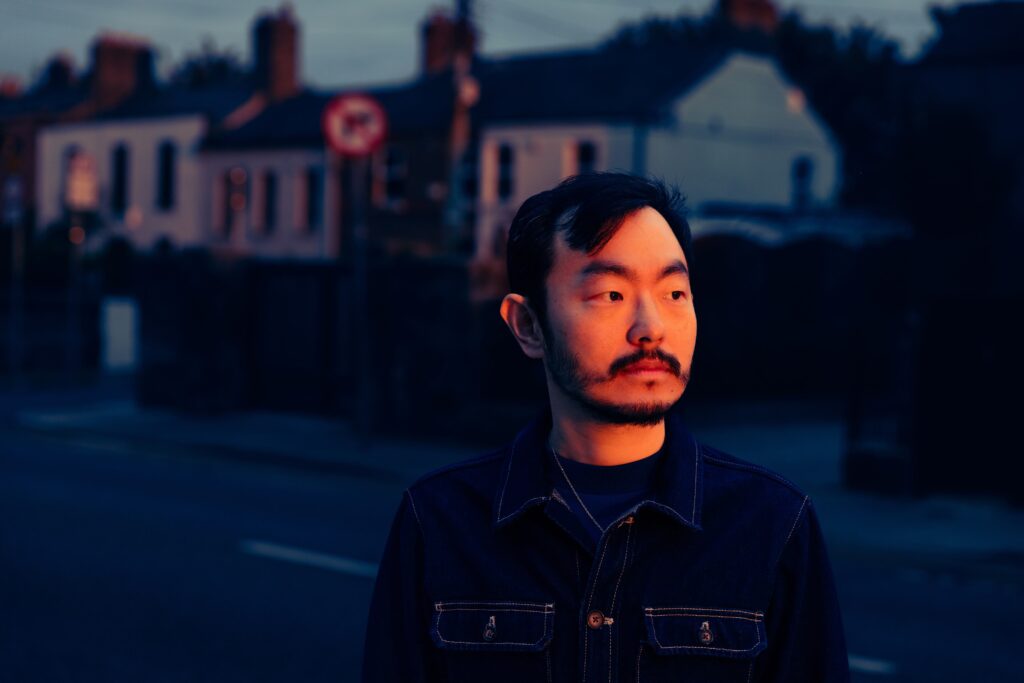
You hold both Japanese and Irish roots. Would you say that such a diverse background has had a role in sculpting your eclectic artistry?
As I grow older, I’m more convinced that I’m, or at least strive to be, a global citizen. I absolutely believe my plural roots have played a role. I especially appreciate having multiple perspectives, as my worldview was first shaped by Japan, and then later heavily informed by my extensive time making a life in Ireland. This created a natural contrast between two rich and distinct environments.
Having been around truly diverse people, I don’t necessarily view myself as diverse, but perhaps “intersectionalised”. My experience growing up and finding my way across these cultures instilled a capacity for vicarious experience and empathy, which I think is essential to the heart of my art.
Tell us about your journey into music; How did it all start for you? Did you have a specific training or a particular inspiration? Any artists you look up to?
My journey started largely through the Japanese education system, which provided early exposure and resources. My first memories are of melodica lessons, which, being common in Japan, sparked a deeper interest. Crucially, I also took some early piano lessons from a local opera singer. Although short-lived, that time was formative; it gave me access to a real piano and the teacher’s kindness kept me engaged, leading me to buy my first keyboard at age 10.
I continued to build my foundation through school and university: playing the clarinet in a brass band taught me music theory, and then playing bass (both double bass and electric) in high school and university big bands, which continued into mid-university, provided the most practical training. I also learned about PA and staging through a student broadcasting team.
During this period, I was a young carer, and my personal responsibilities became increasingly heavy. Unavoidable transitions in my life circumstances meant that playing in bands became unrealistic. I then shifted my focus to working on my Korg synthesiser privately. This period of instability and intense pressure constantly tested my passion, but it forced my creativity to become quiet and internalised.
I look up to Japanese artists like Sheena Ringo, Hikaru Utada, Spitz, and Kirinji. My international influences, even from those early days, include Björk, Donald Fagen, Rufus Wainwright, and Corinne Bailey Rae.
It all takes us to your latest effort, ‘Hypernonchalant’, a wide-ranging album packed with evocative songwriting and wondrous productions. How long was the record in the making? Are you proud of how it turned out? We should probably mention your collaboration with platinum-selling French producer YDTHXGRT…
The earliest conceptual work began in late 2021. The project’s direction was only clear in retrospect, as it grew organically from the collaborative remix work we did previously. That project started with my songs; this time, we chose to work in reverse, starting with beats. We exchanged reference tracks and foundational ideas to develop the initial direction. The beats were completed by 2022, which became the basis of ‘Hypernonchalant’.
It was a rigorous process, and my extensive input led him to fondly call me one of the most ‘exigeant’ (demanding) artists he had worked with.
The biggest challenge for me was building my version of ‘flow’ to align with the beats, ensuring I didn’t drift from what’s inherently in me. It was a delicate process of striking a balance, like making two cards lean on each other to stand. I was seeking integrity, working on the songs until they felt as if they had always existed. I approached the lyrics last, accumulating and developing ideas through 2023, followed by final vocal recordings in 2024.
I’m glad that the entire project came to completion and achieved the nuanced objective I aimed for.
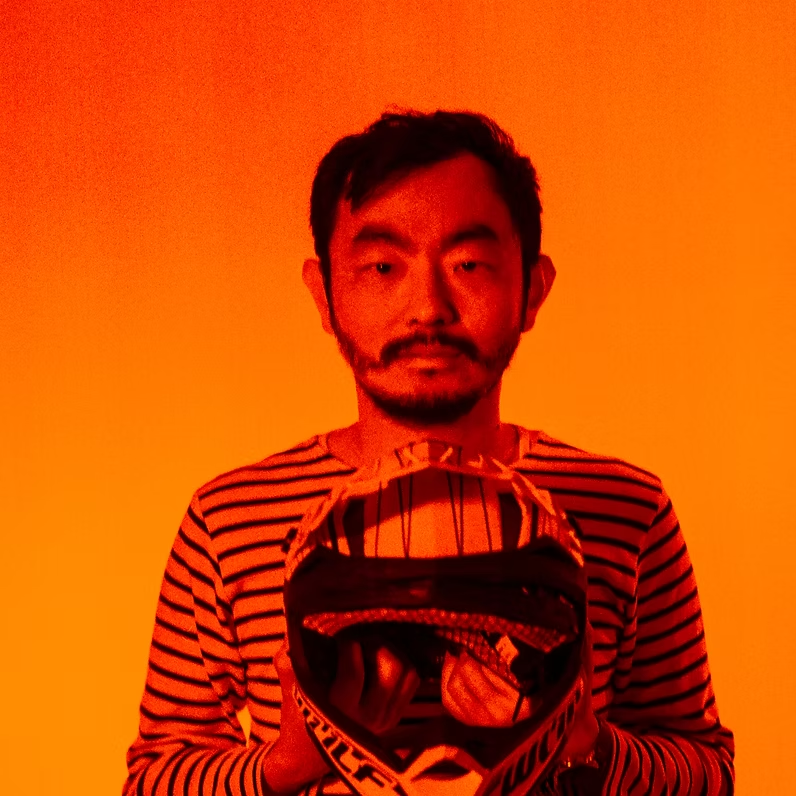
Lyrically, is there an overarching theme in it? Do you have any ‘favourite’ tracks?
Definitely. I designed the album as a song cycle, aiming to depict something that sheds light on trauma in a 21st-century light. The title ‘Hypernonchalant’ itself is intended to sound like a hypothetical symptom of it. The album is a kind of ‘toy model’ of an insomniac night of an affected person. I wanted to address trauma without the typical ‘soldier’ connotation.
Although I must admit each song has a special place in my heart, ‘Gut Feeling’ is a favourite. I enjoyed mixing seriousness and tongue-in-cheek-ness in the words and expressions, and using almost obsessive rhyming variations. Another key track is ‘The Spectatoring’, which was my challenge to write an R&B-influenced song about intimacy, resulting in my own version of vulnerability.
My lyrics are an aspect I’ve focused on, as I noticed there aren’t many songs written gender-neutrally or without proper nouns. It’s an artistic choice that I intuited might allow for wider interpretations. Additionally, the lyrical economy of the Japanese language inspires particular aspects of these songs, as I aim to encapsulate layers of meaning into relatively few words. The album title Hypernonchalant was chosen later for its dual meaning and French resonance, which plays nicely with the small number of French-origin words sprinkled throughout the album.
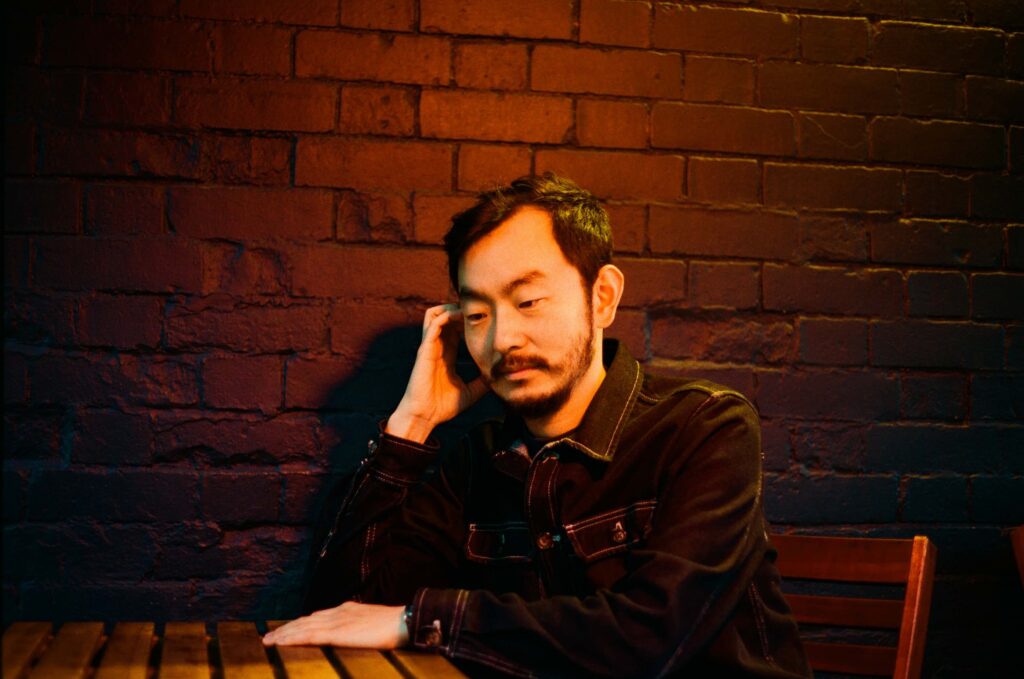
Widening the question, I’d love to know more about your creative process. Do you usually like to write alone or with others? Would you define music-making as a foundational part of who you are as a human?
Although writing on my own comes more naturally to me, both working solo and in a group are necessary, like the two wheels of a vehicle, each informing and fuelling the other.
I don’t have a ‘usual’ process, as I don’t typically sit down and write song-by-song. I liken it to star formation: I start with a complex, enigmatic concept, and I do my best to break down and classify that mass of ideas into digestible pieces (the songs) to help each piece align according to its own “mass”, and hence “gravity”. They each contribute integrally to the whole. My process seems to involve constant iteration and going back and forth, rather than a linear track-by-track creation.
Music-making is an integral part of me. It’s something entirely out of the equation of wealth, status, or job; I’ve literally kept doing it even when I had nothing. I know I do it for myself, or perhaps more precisely, for my life. I’m an avid listener, but I felt like I might put out something that I haven’t quite heard or that I wished existed.
Here’s something I always ask – the answers tend to be quite interesting. Given your specific journey in music, is there a particular piece of advice or nugget of wisdom you could share with our readers? (Many of whom are up-and-coming artists themselves)
I truly think I’m not the type who can give advice, but to share my view, I’d say humanity and integrity really matter.
For me, the main inspiration isn’t music itself, but non-music. While I educate myself constantly, music for the sake of music tends to be uninteresting to me; my ears tend to seek something beyond that. Also, I find that when a piece seems driven by ego or habit (while they are admittedly aspects of humanity), I lose interest. I believe an artist’s motivation and vision are directly relevant to their consistency and meaningfulness. Personally, I enjoy at least a good balance of arbitrariness and intentionality in the creative process and the end result.
All this is, of course, highly subjective. In this sense, I appreciate the depth and vastness of music, which seems to accommodate almost any subjectivity. On a practical note, I find myself handwriting all the time. I don’t do it for creative purposes, but it allows the running water of ideas to remain pure, and somehow heightens my sensitivity to serendipity. Probably any artist has, or can develop, a routine to keep their internal ‘pipes’ clean (for both input and output).
Lastly, what’s next for Tomonori? Any live shows on the horizon?
My approach to live performance is intentional: I’d like to ‘tour’ locally, slowly and steadily. I’m not the type to aggressively gig, but I aim to make genuine connections and find trusted friends in the scene. This slow, deliberate approach suits my personality and allows me to maintain a sustainable and thoughtful creative practice.
I’m continuously building on my creative momentum through various projects. I aim to play the studio versions live; moreover, I actively seek to innovate beyond them by rearranging and experimenting with the tracks, pushing them into new versions, and potentially incorporating visuals and motion graphics. This keeps the music fluid, offering something unique and fuelling my ongoing work.